Anki Vector 2 0 · Volume 8
Acquisition & Setup
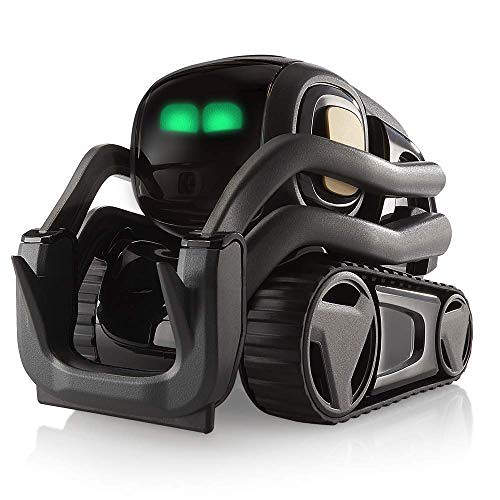
Vector is a used-market robot. The company that made it is bankrupt; the company that revived it is dormant and the subject of a consumer-protection lawsuit; and the cloud the robot phoned home to has been dead since mid-2023. A prospective buyer who wants a fully functional, revival-ready unit today must buy used — and must understand which hardware generation, which firmware state, and which recovery path align with intended use. This volume covers the market, the SKUs, the pre-purchase inspection, the firmware fork, and the end-to-end revival path from box to working robot.
8.1 Why new stock is not an option
Digital Dream Labs (DDL), the current IP holder, lists Vector 2.0 on anki.bot but reports it as “sold out” (anki.bot; CONFIRMED). DDL’s office is reported vacated, and the company’s operational status is in serious doubt. In September 2024, Pennsylvania Attorney General Michelle Henry filed suit against DDL and CEO H. Jacob Hanchar over approximately 14,000 prepaid orders — products including Vector 2.0, Cozmo 2.0, and Butter Robot — that were never fulfilled. The unfulfilled orders total more than $4M (some accounts say $2M+; a conflict noted in both directions — CBS Pittsburgh); individual orders ranged from $147 to $655. The suit invokes the Pennsylvania Unfair Trade Practices and Consumer Protection Law (UTPCPL) and the FTC Mail Order Rule and seeks restitution, per-violation penalties of $1,000–$3,000, and an injunction. The outcome is unknown as of June 2026 (CBS Pittsburgh; CONFIRMED on the suit, outcome UNVERIFIED).
A 2026 “Anki is back” relaunch headline exists but is UNVERIFIED — treat it as unconfirmed marketing until a primary source confirms resumed operations (TechTimes, flagged; wiki.thedroidyouarelookingfor.info; UNVERIFIED). With the cloud dead, direct ordering risky, and no new stock confirmed available, the used market is the only reliable path.
8.2 The used market
8.2.1 Price ranges
Vector 2.0 — the DDL-era upgraded unit with a 2 MP 120° ultra-wide camera — is commonly cited at approximately $400 on the used market (CBS Pittsburgh; CONFIRMED).
Original Anki-era Vector units (1.0) trade for less. A single secondary aggregator reports per-color SKU prices of Black at $199.99, Pink at $219.99, Blue at $249.99, and Red at $299.00 (UNVERIFIED — single secondary source, ankicozmorobot; treat as a ballpark reference, not a confirmed figure). A plausible used-market estimate for original Vector units is roughly $200–$350, though individual transactions vary with condition and completeness.
The exact OSKR kit price — for buyers seeking a pre-unlocked or newly unlockable unit — is NOT FOUND in any reachable source (oskr.ddl.io returned a TLS certificate error; the OSKR README 404’d). Community aggregators have cited roughly $250–$299.99 for open-box OSKR-variant units (UNVERIFIED; ankicozmorobot).
8.2.2 SKU distinctions
Three generations circulate in the used market:
Anki-era units are the original 2018–2019 production run, carrying the Anki brand on packaging. These are fully compatible with wire-pod (wire-pod README; CONFIRMED). The camera on these units is community-cited as HD/720p, though one snippet claims 1080p — a conflict left unresolved (UNVERIFIED for either figure; see Vol 3). The Snapdragon APQ8009 platform is shared across all generations.
DDL-era units (2021 relaunch) use the same chassis and Snapdragon platform. Distinguishing a DDL relaunch unit from an Anki original requires reading the box labeling or confirming the camera specification through the wire-pod web UI or DDL’s packaging.
Vector 2.0 is the DDL SKU upgrade. Its camera is definitively 2 MP at 120° ultra-wide FOV (anki.bot; wevolver; CONFIRMED). A community source also reports a redesigned battery compartment and a more reliable chassis on 2.0 versus 1.0 (UNVERIFIED; ankicozmorobot). Wire-pod supports both 1.0 and 2.0 on unmodified production hardware (wire-pod README; CONFIRMED). For computer-vision work or use of the Python SDK’s camera feed, the 2.0 camera is meaningfully better.
OSKR-converted (“Dev”) units occasionally appear on the used market. These have had
the bootloader unlocked (see Vol 5) and require no further OSKR purchase. They
immediately support system-partition flashing and the full SDK-grade access path —
including vector_ros2 (Vol 7), which explicitly requires OSKR (github.com/nilseuropa/
vector_ros2; CONFIRMED). Given that DDL has been unable to issue new OSKR keys since
mid-2023 (wiki.thedroidyouarelookingfor.info; CONFIRMED), a pre-unlocked used unit is
the only reliable route to OSKR status today.
8.3 Pre-purchase inspection
8.3.1 Completeness
Every Vector ships with two accessories essential to normal operation:
- The charging dock. Vector navigates to its dock autonomously when battery is low (anki.bot; iFixit). Without a dock the robot cannot charge through its normal autonomous dock-return path. Verify the dock is included, or budget to source one separately.
- The cube. The cube is the robot’s primary interactive prop — Vector can locate it, push it, and interact with it as part of its autonomous behaviour (iFixit; anki.bot). The cube is confirmed as part of the base experience; without it the robot functions but a significant interaction mode is unavailable.
8.3.2 Boot verification
Confirm the robot powers on before completing any purchase. Vector uses a Li-poly battery with approximately 30–40 minutes of runtime (battery chemistry CONFIRMED; runtime CONFIRMED; wevolver; thedroidyouarelookingfor). Batteries age; a used unit may exhibit substantially reduced runtime even if it powers on cleanly. The manufacturer’s official capacity figure is NOT FOUND in any reachable source — the Vector Technical Reference Manual (the likely route to the exact figure) was not text-extractable for this dive. Aftermarket replacement packs are community-cited at 500 mAh 3.7 V and refurbishment sources at 600 mAh; neither figure is confirmed against factory specifications (UNVERIFIED; thedroidyouarelookingfor; community aggregators). Battery condition is the most common aging concern on used units; a robot that barely holds a charge is common at lower price points.
Battery and charging caution:
_shared/safety.mdcovers the general battery charging protocol that applies to all robots in this hub — charge on a non-flammable surface, in a ventilated space, attended. Those cautions apply equally to Vector’s Li-poly cell. Inspect the battery and dock contacts for physical damage before first use on any used unit.
8.3.3 Firmware state
Establish the current firmware version before purchase, either by asking the seller or by booting the robot and checking through the settings menu. The firmware version determines which setup path applies:
- Production / OTA firmware is the factory state on all retail units and the starting point for wire-pod setup. Production bots require the “ep” firmware variant supplied by wire-pod — not the standard OTA release — to work with the local server (wire-pod wiki; CONFIRMED). The “ep” variant is applied as part of the standard wire-pod setup procedure (see Vol 6); no hardware modification is required.
- OSKR / “Dev” firmware indicates the bootloader has been unlocked. A pre-unlocked
unit is ready for system-partition flashing and the full SDK-grade path without any
further OSKR action. If the buyer plans to run
vector_ros2or perform firmware customisation, a pre-unlocked unit is the cleanest starting point (see Vol 5).
8.4 Buyer intent determines the firmware path
The three recovery tiers map cleanly to buyer goals:
Table 1 — The three recovery tiers map cleanly to buyer goals
| Goal | Requires | Robot state |
|---|---|---|
| Restored voice and autonomous behaviour | wire-pod (free) + “ep” firmware | Any unmodified production unit |
| Python SDK control | wire-pod + wirepod_vector_sdk | Any unmodified production unit |
| ROS 2 integration / system-level access | OSKR unlock + wire-pod | Pre-unlocked (“Dev”) unit only |
A buyer who wants only a working companion robot — speech, timer, reactions, wandering
behaviour — needs only wire-pod and no hardware modification. A buyer who wants Python
SDK access to sensors, vision, mapping, and animations can add wirepod-vector-python-sdk
(pip install wirepod_vector_sdk) with no hardware change (github.com/kercre123/
wirepod-vector-python-sdk; CONFIRMED). A buyer who wants full ROS 2 integration via
vector_ros2, or the ability to flash custom firmware, needs OSKR — and since DDL has
not issued new keys since mid-2023, only a pre-unlocked used unit reliably meets that
requirement (wiki.thedroidyouarelookingfor.info; CONFIRMED).
8.5 The revival path at a glance
Once a unit is in hand, the end-to-end recovery sequence is straightforward:
- Acquire a used unit with dock and cube; verify it boots and holds a charge.
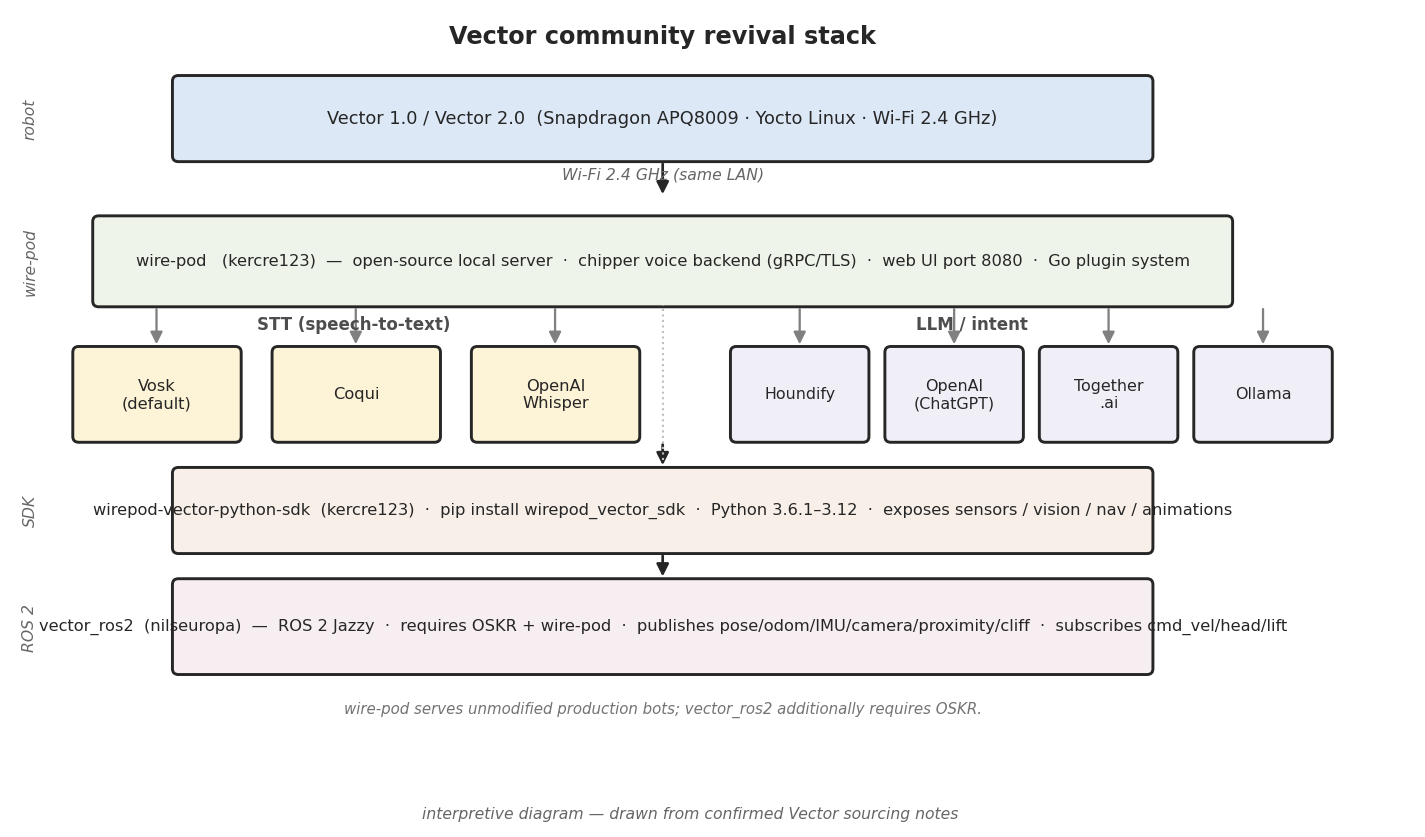
- Set up wire-pod — install the free open-source local server on a host machine (Linux, macOS, Windows 10/11, or Android; a Bluetooth-capable host is required for initial pairing); flash the “ep” firmware variant to the robot; register the robot through the wire-pod web UI at port 8080. Wire-pod replaces the dead DDL cloud and restores voice, timer, and knowledge-graph functions using local STT (Vosk by default; Coqui and OpenAI Whisper are alternatives) and an optional LLM backend (wire-pod wiki; CONFIRMED). Full setup procedure: Vol 6.
- Optionally OSKR-unlock — if purchased pre-unlocked, no further action is needed. If a fresh OSKR conversion is desired, DDL’s inability to issue keys since mid-2023 makes this path currently uncertain (CONFIRMED; wiki.thedroidyouarelookingfor.info). Vol 5 documents the full unlock procedure and its current status.
- Drive it — install the community Python SDK for scripted control of sensors,
vision, navigation, and animation (Vol 7). For ROS 2 integration on an OSKR-unlocked
bot, deploy
vector_ros2(github.com/nilseuropa/vector_ros2; CONFIRMED).
8.6 Cross-references
- Vol 5 — OSKR: the bootloader unlock procedure, what “Dev” mode enables, and DDL’s key-issuance status as of mid-2023.
- Vol 6 — wire-pod: the full setup guide, “ep” firmware flashing, STT and LLM backend configuration, and the web UI at port 8080.
- Vol 7 — the community Python SDK and the ROS 2 integration path via
vector_ros2.
Sources
- CBS News Pittsburgh, “PA Attorney General lawsuit: Digital Dream Labs” — the Sept 2024 enforcement action; the unfulfilled-orders total ($4M+ vs $2M+, conflict recorded both ways); the commonly-cited ~$400 Vector 2.0 used price (CONFIRMED).
- anki.bot / Digital Dream Labs — live vendor site; Vector 2.0 listed but “sold out” (CONFIRMED); © 2026.
- wiki.thedroidyouarelookingfor.info — community technical wiki: DDL cloud-shutdown timeline; OSKR key-issuance status (no new keys since mid-2023, CONFIRMED); battery-capacity community citations (UNVERIFIED).
- wevolver, “Vector 2.0 AI Robot Companion” — 2 MP / 120° camera spec (CONFIRMED); 30–40 min runtime (CONFIRMED); Li-poly battery type (CONFIRMED).
- anki.bot, “Meet Vector” — camera and feature set confirmation.
- ankicozmorobot.com/vector-robot/ — per-color SKU prices (UNVERIFIED, single secondary source); Vector 2.0 chassis/battery-compartment redesign claim (UNVERIFIED).
- iFixit, “Anki Vector” device page — dock, cube, and physical form-factor confirmation.
- wire-pod README and wiki (github.com/kercre123/wire-pod) — Vector 1.0/2.0 support on unmodified production bots; “ep” firmware requirement; STT options; web UI port 8080 (CONFIRMED).
- github.com/nilseuropa/vector_ros2 — OSKR + wire-pod requirement for the ROS 2 path (CONFIRMED).
- github.com/kercre123/wirepod-vector-python-sdk — Python SDK install and capability set (CONFIRMED).
- personalrobots.biz/vector-escape-pod-and-open-source-kit/ — OSKR purpose and scope.
_shared/safety.md— general battery charging cautions (non-flammable surface, ventilated, attended); applicable to Vector’s Li-poly cell.- Full gated fact base with CONFIRMED / UNVERIFIED / NOT FOUND markers and source
reachability:
02-inputs/vector_sourcing_notes.md.
Comments (0)