Heathkit HERO Jr (RT-1) · Volume 5
Speech & Personality — A Robot That Sings, Guards, and Gabs
5.1 What this volume covers
Two of the HERO Jr’s defining features sit on its front panel and answer to the same idea: that the robot should do something the moment it is switched on, without its owner writing a line of code. The first is a built-in voice — a Votrax phoneme synthesizer that, on the HERO Jr, is standard equipment rather than an extra-cost board. The second is a set of “personality” programs baked into the robot’s unusually large ROM, each started by pressing a single labelled key: Sing, Play, Poet, Gab, Alarm, Guard, Help, Plan. This volume describes the voice hardware, the LED display that flashes along with it, and what the labelled keys are documented to do — and it is deliberate about where the documented record stops and where it leaves a behaviour unclaimed.
The HERO-Jr-specific facts here — that speech is built in, that it is built on the
Votrax SC-01, that the front panel carries a row of LEDs that flash with the
voice, that the personality keys exist and are named as listed — are gated to the
HERO Jr record (the HERO FAQ at hero.dsavage.net; theoldrobots.com; the
partofthething.com retrospective, “Dilettante”). The general behaviour of the
Votrax part — how phoneme formant synthesis turns a stream of numeric codes into
continuous English — is the same chip described in the HERO 1 speech volume and is
attributed there, and here, to the Votrax SC-01 documentation; describing the
chip’s internals is describing the part, not making an undocumented claim
about the HERO Jr’s particular board.
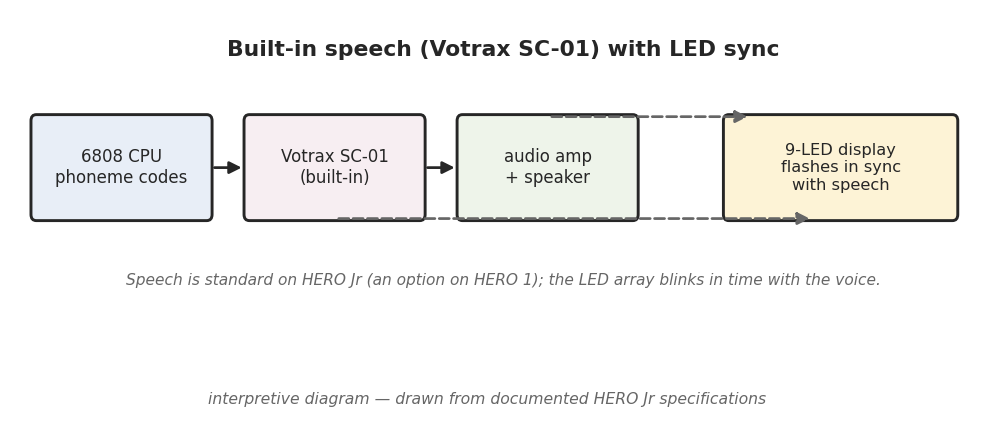
5.2 Speech, built in — the inversion of the HERO 1 option
The single most important fact about the HERO Jr’s voice is organizational, not electrical: it is standard. On the HERO 1, speech was an optional accessory — the ET-18-2 speech board, built on the Votrax SC-01, that an owner bought and fitted separately and that carried its own line on the kit price (covered in the HERO 1 speech volume; Wikipedia, “HERO (robot)”). A HERO 1 without that board was mute. The HERO Jr reverses that choice: the synthesizer is part of the base machine, so every HERO Jr talks out of the box (HERO FAQ; theoldrobots.com).
That inversion follows directly from what the two robots were for. The HERO 1 was an educational platform whose owner expected to add capability deliberately; speech was one capability among many to bolt on. The HERO Jr was a consumer product whose whole appeal was that it arrived doing something — and for a 1984 living-room audience, the thing that read most clearly as robot was a machine that spoke. Making the voice built-in is of a piece with the labelled personality keys and the large ROM: the HERO Jr’s design spends its silicon on being immediately expressive rather than on being a bare canvas.
The voice is also the reason the ROM is as large as it is. The HERO Jr’s 32 KB ROM dwarfs the HERO 1’s roughly 2 KB monitor (Vol 2; HERO FAQ; theoldrobots.com), and that extra room is consistent with holding both the robot monitor and the built-in personality programs — programs whose most audible output is speech. The voice hardware and the personality software are two halves of one feature: ROM programs that, among other things, talk.
5.3 The Votrax synthesizer, in brief
5.3.1 What the chip is
The HERO Jr’s voice is built on the Votrax SC-01, a single-chip phoneme-based formant speech synthesizer (HERO FAQ, “SC-01 based”). The HERO FAQ records the robot’s speech as SC-01-based; the partofthething.com retrospective (Dilettante) identifies the chip as the SC-01A specifically — the later, ROM-tweaked revision of the part with improved synthesis quality. The revision is presented here as per Dilettante: the gated record agrees the synthesizer is from the SC-01 family and one firsthand account names the A revision, so this volume states the family as documented and attributes the specific revision rather than asserting it as settled.
The part itself is the same one described at length in the HERO 1 speech volume, and the chip-level facts below are general SC-01 behaviour attributed to the Votrax SC-01 documentation — they describe what any SC-01/SC-01A does, which is what makes the HERO Jr able to say arbitrary words rather than a fixed recorded list.
5.3.2 How phoneme formant synthesis works
The SC-01 does not store recordings of words. It synthesizes speech from phonemes — the elementary sounds of spoken English — so that stringing the right phonemes together in the right order produces any word, including words no one anticipated when the chip was made (Votrax SC-01 documentation). This is the structural opposite of stored-word playback, where a machine can only ever utter the specific clips recorded into it; the SC-01’s vocabulary is open-ended at the cost of a characteristic synthetic timbre.
The chip carries a fixed repertoire of 64 phonemes, each selected by a 6-bit code (2⁶ = 64, so the code space and the phoneme set match exactly); the phoneme symbols are a modified form of the ARPAbet phonetic alphabet (Votrax SC-01 documentation). To make the chip speak, software presents one 6-bit code, lets the chip render that phoneme, then presents the next — speech is the chip working through a stream of phoneme codes in order. Because each utterance is just a short list of small numbers, the data rate is modest — the SC-01 documentation gives a figure on the order of 70 bits per second for continuous speech — so a slow 8-bit host (the HERO Jr’s 1 MHz 6808, Vol 2) can keep the chip fed without strain (Votrax SC-01 documentation).
What the chip does with each code is formant synthesis. Human speech sounds are shaped by formants — the resonant peaks the vocal tract imposes on the sound from the vocal cords — and the ear identifies a vowel largely from where those peaks fall. The SC-01 generates sound from scratch with a model of that vocal tract: an excitation source (a buzzy periodic waveform standing in for the vocal cords on voiced sounds like vowels, or a noise source for unvoiced sounds like s and f) passed through a bank of filters tuned to the target phoneme’s formant frequencies (Votrax SC-01 documentation). The incoming 6-bit code selects the filter and timing parameters for one phoneme; crucially, the chip glides between successive phonemes’ formant targets rather than snapping between them, so a string of discrete codes runs together into connected speech rather than a sequence of isolated beeps. That gliding is also the source of the distinctive Votrax sound.
The chip provides a little prosody as well: beyond phoneme selection it accepts inflection bits giving four levels of intonation (pitch), enough to put a rising contour on a question or a falling one on a statement, though far from natural human melody (Votrax SC-01 documentation). For the HERO Jr that small amount of pitch control is what separates the personality programs’ speech from a dead monotone.
5.3.3 What this buys the HERO Jr
Built on the SC-01, the HERO Jr can in principle say anything that can be spelled in phonemes — the personality programs in ROM are not limited to a fixed dictionary of recorded clips but emit phoneme streams the chip renders on the fly. What the robot actually says under each key is a property of those ROM programs, and the gated record does not enumerate their scripts; what is documented is the mechanism — open-vocabulary phoneme synthesis — that makes a singing, reciting, chattering robot possible from a 32 KB ROM rather than from megabytes of stored audio.
5.4 The display that flashes with the voice
Across the front of the HERO Jr is a row of LEDs that flash in time with the speech — the robot’s mouth, in effect, blinking as it talks (theoldrobots.com; HERO FAQ). The display is described as a nine-LED array in the headline specs (theoldrobots.com; HERO FAQ), and that nine-LED figure is the one carried through this deep dive’s overview (Vol 1). It is worth flagging a wording conflict in the record: alongside the nine-LED display description, theoldrobots’ accessory text states that “eight LEDs flash in time with speech.” Whether the discrepancy is a true count (nine LEDs total, eight of which animate with the voice) or simply a loose count in one source is not resolved by the gated record, and this volume does not pick a winner: the display is a small row of LEDs that flashes with the voice, documented as nine LEDs with one source saying eight flash with speech (theoldrobots.com; HERO FAQ).
Either way, the display’s function is the same and is the reason it earns a place in a speech volume: it is not a numeric readout in the manner of a calculator but a speech-synchronized indicator, lighting in step with the phoneme stream so the robot appears to be speaking rather than merely emitting sound. It is the visual half of the same expressiveness the built-in voice provides — cheap, legible feedback that the machine is “alive” and talking, aimed squarely at the living-room audience the HERO Jr was sold to.
5.5 Personality — programs in ROM, one per key
5.5.1 The one-touch model
The HERO Jr’s keypad is a 17-key rubber keypad on the head (theoldrobots.com; HERO FAQ), but in its first and intended use it is not a machine-code monitor at all — it is a row of labelled behaviour keys. Pressing a key starts a “personality” program already living in the 32 KB ROM (Vol 2); the owner selects a behaviour rather than writing one (theoldrobots.com; HERO FAQ; Dilettante). The documented set of labelled keys is Sing, Play, Poet, Gab, Alarm, Guard, Help, Plan, plus Setup and Enter (theoldrobots.com; HERO FAQ; Dilettante).
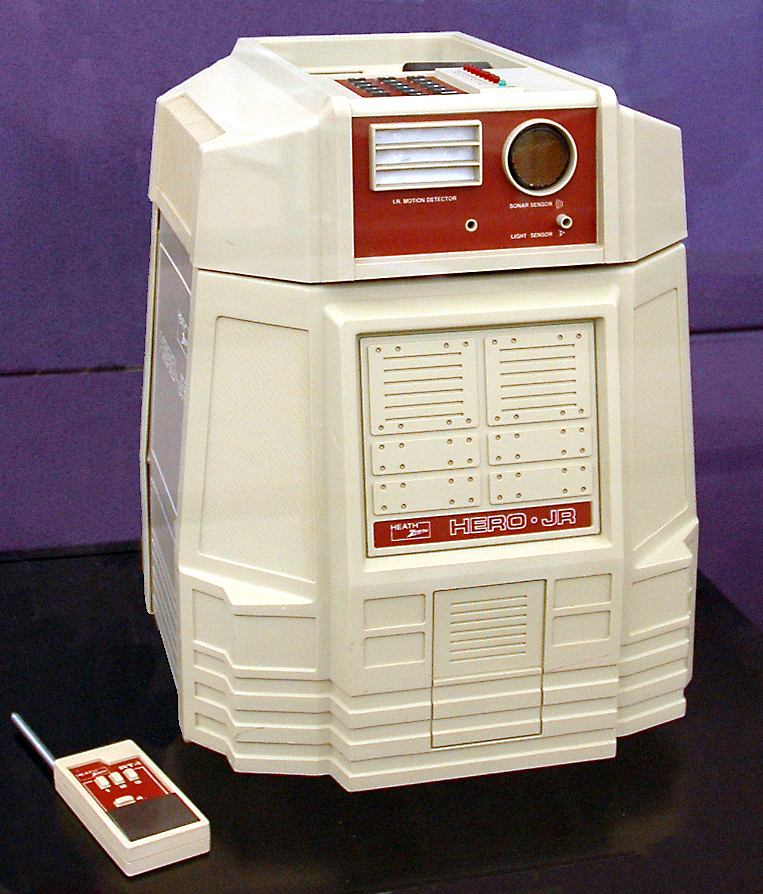
The names group naturally into the behaviours that gave this volume its title — a robot that sings, stands guard, and gabs — and into a couple of control keys that operate the others. The table below lists the documented keys and states, for each, exactly what the gated record supports and where it stops.
Table 1 — The one-touch model
| Key | What the record documents | Status of the detail |
|---|---|---|
| Sing | The robot sings | Documented (Vol 1; theoldrobots; HERO FAQ) |
| Poet | The robot recites | Documented (Vol 1; theoldrobots; HERO FAQ) |
| Guard | The robot watches the room and reacts to intrusion | Documented (Vol 1; theoldrobots; HERO FAQ) |
| Gab | A talking/chatter behaviour (the robot speaks) | Name documented; exact script not in the gated record |
| Play | A play behaviour | Name documented; exact behaviour not in the gated record |
| Alarm | An alarm behaviour | Name documented; exact behaviour not in the gated record |
| Help | A help behaviour | Name documented; exact behaviour not in the gated record |
| Plan | A planning behaviour | Name documented; exact behaviour not in the gated record |
| Setup | Configuration / control key for the personality programs | Documented as a key; not itself a personality |
| Enter | Entry / confirm control key | Documented as a key; not itself a personality |
5.5.2 The keys the record describes
Three of the personality keys are described in the gated record beyond their names, and they are the three this volume names in its title:
-
Sing. Pressing Sing makes the robot sing (Vol 1; theoldrobots.com; HERO FAQ). Sung output is the SC-01 voice driven with the chip’s four-level pitch control (above) to carry a melody — a natural showcase for a built-in synthesizer, and one of the demonstrations the consumer pitch leaned on. The exact songs in ROM are not enumerated by the gated record.
-
Poet. Pressing Poet makes the robot recite (Vol 1; theoldrobots.com; HERO FAQ) — the synthesizer reading stored verse aloud. As with Sing, the specific contents are a property of the ROM program and are not tabulated in the gated record.
-
Guard. Pressing Guard puts the robot into a watch behaviour: it monitors the room and reacts to intrusion (Vol 1; theoldrobots.com; HERO FAQ). This is the personality that ties most directly into the sensor suite (Vol 4) — the sonar, the sound sensor, and, where fitted, the optional infrared motion detector (RTA-1-2) are exactly the inputs a guard behaviour would react to, and an Alarm-style spoken or audible response is the natural output. The precise trigger logic and response are governed by the ROM program and are not detailed in the gated record.
5.5.3 The keys the record names but does not detail
The remaining personality keys — Play, Gab, Alarm, Help, Plan — are documented to exist and to be labelled as listed (theoldrobots.com; HERO FAQ; Dilettante), but the gated record does not spell out what each program does step by step. Their names are suggestive — Gab implies a talking/chatter behaviour, Alarm an alerting one, Help a guidance or explanation behaviour, Play an entertainment or game behaviour, Plan some form of scheduling or routine- building — but the precise behaviour behind each key is not established by the gated record and is left unclaimed here rather than invented. What is firmly documented is the pattern: each labelled key starts a self-contained behaviour program that lives in ROM, and the suite as a whole turns the robot into something that talks, reacts, entertains, and guards at a single press. The authoritative account of any one program’s behaviour is the factory HERO Jr Owner’s Guide and Programmer’s Guide, which a reader should consult for the exact scripts.
5.5.4 Setup and Enter — control, not personality
Two of the labelled keys are not personalities at all. Setup and Enter (theoldrobots.com; HERO FAQ; Dilettante) are control keys: Setup is the configuration-style key for the personality system and Enter is the entry/confirm key. They are listed alongside the behaviour keys because they share the same 17-key pad, but they operate the personalities rather than embodying one. Their exact, per-keystroke function is documented in the Owner’s/Programmer’s Guides; this volume names them as control keys and does not assert a behaviour for them.
5.6 Pick a behaviour, no code — and the path deeper
The personality keys are the clearest expression of the HERO Jr’s consumer design. Where the HERO 1 presented its owner with a bare hexadecimal keypad and an expectation that they would write machine code before the robot did anything interesting, the HERO Jr presents a menu of finished behaviours and asks only which one (theoldrobots.com; HERO FAQ; Dilettante). The capability is built in; the owner selects rather than authors it. That is the same move as making speech standard rather than optional — both spend the larger ROM and the consumer division’s engineering on immediate, code-free expressiveness.
The depth is still there for owners who want it. The HERO Jr can be driven from an RF remote, programmed in its own keypad language (HJPL, the HERO Jr Programming Language), or run BASIC from the RTC-1-8 cartridge over an RS-232 link — the routes by which an owner goes beyond the one-touch keys to script the robot’s voice and behaviour directly. Those routes, including how a program of one’s own would drive the SC-01 with phoneme codes in the manner Figure 1 traces, are the subject of Vol 6 (programming) and the cartridge/accessory ecosystem of Vol 7. The personality keys are where the HERO Jr starts; they are not where it ends.
Every hard speech-and-personality fact in this volume is collected, with the rest of the machine’s numbers, in the Vol 9 cheatsheet.
Sources
- HERO FAQ (
hero.dsavage.net) — the HERO Jr’s built-in, SC-01-based speech (standard, not optional); the nine-LED display that flashes in time with speech; the 17-key rubber keypad and the labelled personality keys; the 32 KB ROM holding the robot monitor and built-in programs. - theoldrobots.com — the nine-LED display and the “eight LEDs flash in time with speech” accessory wording (the 8-vs-9 conflict flagged in-text); the full list of personality keys (Sing, Play, Poet, Gab, Alarm, Guard, Help, Plan, Setup, Enter); built-in speech as standard.
- partofthething.com (“Dilettante”) — firsthand retrospective identifying the speech chip as the SC-01A revision (attributed; the family is documented, the specific revision is per Dilettante); the personality-key / one-touch model and the deeper programming paths (HJPL, BASIC cartridge, RF remote).
- Votrax SC-01 documentation — general behaviour of the part: a phoneme-based formant speech synthesizer producing continuous speech from a stream of 6-bit phoneme codes; 64 phonemes (modified ARPAbet); four levels of intonation; the SC-01A revision; the order-of-70-bits-per-second data rate. (Describes the chip, not an undocumented claim about the HERO Jr’s board.)
- HERO Jr Owner’s Guide / Programmer’s Guide (Internet Archive) — the authoritative primaries for the exact behaviour of each personality program and the Setup/Enter control keys; consult them for the per-key scripts this volume leaves unclaimed.
Comments (0)