Heathkit HERO Jr (RT-1) · Volume 8
Acquisition, Restoration & Interfacing Today
8.1 What a HERO Jr is on the collector market
A HERO Jr coming up for sale today is a forty-year-old consumer robot, and the
first thing to establish about any given unit is which one it is. Heathkit sold
the machine two ways: the factory-assembled RT-1 and the RTW-1 kit that
the original owner built up over roughly twenty hours of work (theoldrobots.com;
HERO FAQ, hero.dsavage.net; HERO Jr Owner’s Guide, which covers both). Both
carry the same electronics, so on the bench the distinction is mostly one of
provenance and build quality — an RTW-1 is only as good as the hands that
soldered it, while an RT-1 left the factory to a fixed standard. A surviving
robot may be either; the model badge and the documentation that comes with it
are the way to tell.
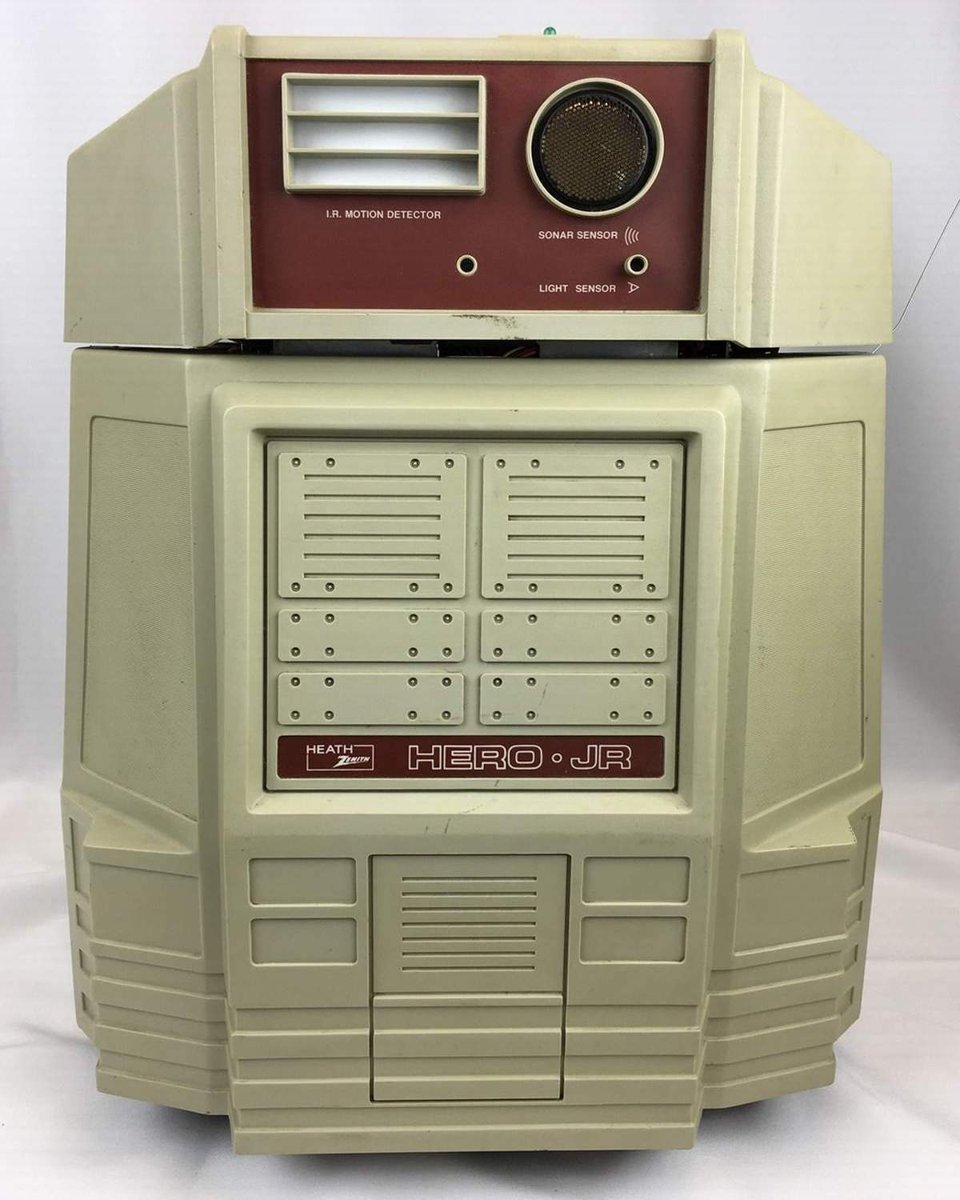
8.1.1 Completeness is the real variable
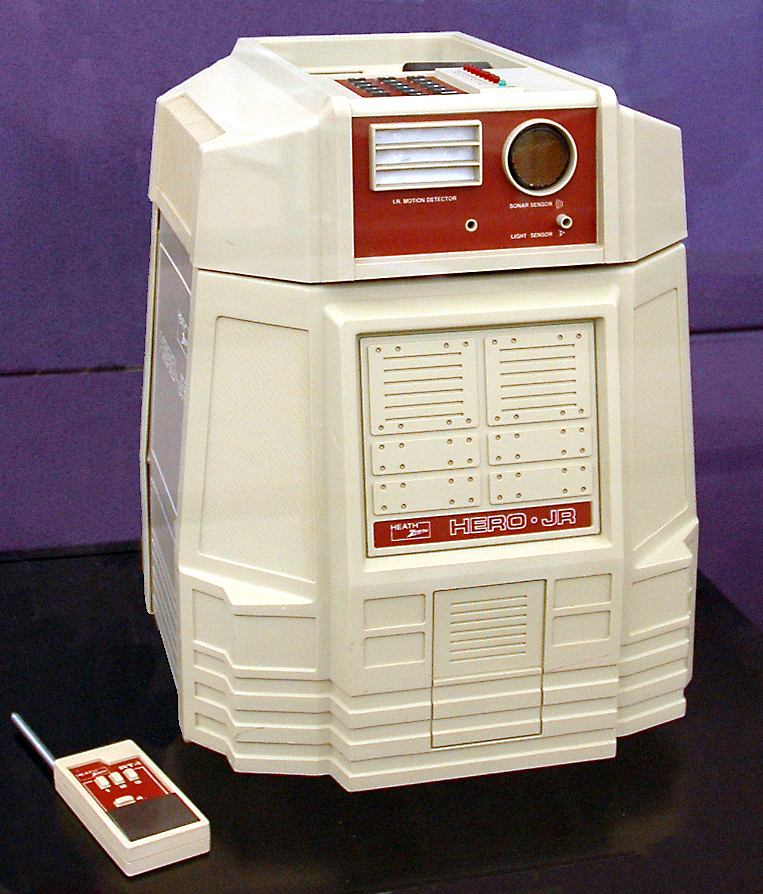
Because the HERO Jr was built around a consumer expansion ecosystem rather than a bare programmable core, completeness drives what a unit actually is. The robot shipped able to roam, sense, and speak on its own, but much of its documented range lived in removable parts: the RTC program cartridges (RTC-1-1 through RTC-1-11, including the RTC-1-8 BASIC cartridge), the RTA accessories (among them the RTA-1-2 infrared motion detector and the RTA-1-4 extra-battery pack), and the RF remote control (theoldrobots.com; Dilettante, partofthething.com; and the remote is visible in the Wikimedia photo below). A robot offered with its remote, one or more cartridges, and the matching accessories is a materially different object from a bare body — see Vols 6 and 7 for what each of those parts does. None of these is required for the robot to power up and run its built-in personality keys, but their presence or absence is the main thing that separates one listing from another.
8.1.2 What one is worth
Hard pricing for a machine that sold in the low thousands of units over the HERO line’s run is thin, and this volume does not invent it. The one figure in the gated record is from Wikipedia (“HERO (robot)”), which notes that secondary-market units have sold for around $100 — against a new price of roughly $600 in 1984 (Wikipedia; Dilettante). That $100 figure is best read as anecdotal: it is a single attributed data point, not a market index, and it says nothing about condition, completeness, or whether the cartridges and remote were included. The sensible takeaway is qualitative — a working, reasonably complete HERO Jr is an uncommon but not unobtainable collectible, and completeness (cartridges, accessories, remote) moves its value far more than cosmetic condition alone.
8.2 The documentation that makes restoration possible
The single most useful fact for anyone restoring a HERO Jr is that the factory documentation is freely downloadable, not locked behind a borrow-only loan. The HERO Jr Owner’s Guide and the HERO Jr Programmer’s Guide are both on the Internet Archive, and the HERO Jr BASIC manual for the RTC-1-8 cartridge is hosted online as well (Internet Archive; the-liberator.net). These are the authoritative primaries: the Owner’s Guide covers operation, the personality keys, and routine care; the Programmer’s Guide documents HJPL and the deeper control paths (Vol 6). A restorer should treat them as the first stop for any procedure this volume keeps deliberately high-level — the manuals carry the exhaustive detail, and gating restoration work to them is the safest path.
8.3 Aging concerns — kept qualitative
After four decades, the subsystems most likely to need attention are the ones that wear, dry out, or corrode rather than the silicon, which tends to survive. The discussion below is deliberately qualitative: the gated record does not support invented failure rates, service intervals, or replacement-part prices, and none are claimed here. What it does support is which parts are the usual suspects.
8.3.1 The two 6 V batteries — the most likely failure
The HERO Jr runs from two 6-volt rechargeable batteries (the documented
nominal capacity is 4.0 Ah each, giving on the order of four hours of normal
exploring; theoldrobots.com), and on a robot this old they are by far the most
likely subsystem to be dead. Sealed lead-acid cells of this vintage do not age
gracefully — they self-discharge, lose capacity, and can leak. Before any
battery or charger work, cross-reference _shared/safety.md. Its battery and
electrical sections apply directly here and are not optional reading:
- Old sealed lead-acid (SLA) cells can leak acid and can deliver very high
short-circuit current — a dead short across a pack can weld tools and start
fires. Fuse the pack, never short the terminals, and dispose of leaking cells
properly (
_shared/safety.md, Batteries). - The robot is charged from a mains-powered charger; treat any opened
mains-side wiring as live, unplug before working inside, verify with a meter,
and replace cracked line cords and failed strain reliefs (
_shared/safety.md, Electrical). - Charge in a safe place — a non-flammable, ventilated surface, attended
(
_shared/safety.md, Batteries).
Replacing aged SLA cells with modern equivalents of the same documented voltage and form is the routine first move on any non-running unit, but the specifics of that swap belong to the Owner’s Guide and to the safety page, not to invented procedure here.
8.3.2 The rubber-membrane keypad
The HERO Jr’s only direct input is the 17-key keypad with rubber keys on top of the head (theoldrobots.com; HERO FAQ), and rubber-membrane keypads of this era are a known wear point in vintage electronics generally: the conductive pads harden, the contacts oxidize, and individual keys can go intermittent or dead. Because every personality behaviour and every HJPL entry passes through this keypad (Vols 5 and 6), a degraded keypad presents as a robot that powers up but will not take commands. The gated record does not document a specific repair, so this volume notes the keypad only as a likely-affected subsystem to inspect, not a procedure to prescribe.
8.3.3 The speaker and LED board
The HERO Jr’s voice and its light show are part of the same presentation layer:
the built-in Votrax SC-01/SC-01A synthesizer drives a speaker, and a row of LEDs
flashes in time with the speech (HERO FAQ; theoldrobots.com; note the gated record
disagrees on whether the array is eight or nine LEDs — see Vol 5). On an aged unit
the things to inspect on this board are the mundane ones common to old audio and
indicator hardware — solder joints, the speaker itself, and any electrolytic
capacitors, which _shared/safety.md flags as drying out or shorting after decades
and worth inspecting for bulging or leaking before full power is applied. No
failure rate is claimed; this is simply where to look if the robot runs but is
silent or its display is dark.
8.4 Interfacing a HERO Jr with a modern PC
For an owner who wants to do more than press the personality keys, the documented path off the robot is its serial RS-232 link — the same link the RTC-1-8 BASIC cartridge uses (Dilettante; the HERO Jr BASIC manual; theoldrobots.com; and see Vol 6 for the full programming picture). RS-232 is a standing, well-understood standard, which makes this the one piece of modern interfacing the gated record fully supports: a HERO Jr’s serial port is trivially bridged to a present-day computer with an inexpensive USB-to-serial adapter, since no modern PC ships a native RS-232 port. That gives a terminal emulator on the host machine a path to talk to the robot over the documented link, exactly as a period serial terminal would have.
The detail that matters in practice — the connector, the signal levels, the line settings, and the exact protocol the robot expects — is the province of the Programmer’s Guide and the BASIC manual, and a restorer should work from those rather than from assumption. This volume confirms only what the gated record establishes: the link is RS-232, it is documented, and bridging it to modern hardware is a solved problem.
8.5 What is left unclaimed
Deeper, undocumented modifications are explicitly not claimed here. The gated
record supports the RS-232 bridge above and nothing further: it does not document
a memory-expansion procedure beyond noting the RTA-1-5 cartridge/RAM adapter and
the headline 2-KB-to-24-KB ceiling (Vols 2 and 7), it does not provide a register
map or a service manual’s worth of test points, and it does not establish any
specific reverse-engineering, ROM-dumping, or hardware-hacking workflow. Where a
restorer goes past the manuals and the serial link, they are past the documented
record — and this volume leaves that ground unclaimed rather than fill it with
invention. The Owner’s Guide, the Programmer’s Guide, and _shared/safety.md
remain the authoritative references for any work on a real machine.
Comments (0)