Heathkit HERO Jr (RT-1) · Volume 9
Cheatsheet — HERO Jr Quick Reference
A dense, single-page reference distilled from Vols. 1–8. Every hard row carries the source it traces to; nothing new is claimed here that is not established earlier in the series. Where the secondary record is uncertain, the row says so. The authoritative primaries for exhaustive detail are the HERO Jr Owner’s Guide and Programmer’s Guide (Internet Archive).
9.1 At a glance
Table 1 — At a glance
| Attribute | Value | Source |
|---|---|---|
| Name | HERO Jr — Heathkit home “personal robot” | Wikipedia; theoldrobots |
| Models | RT-1 (assembled), RTW-1 (kit) | theoldrobots; Owner’s Guide |
| Year | 1984 | Wikipedia; Dilettante |
| Price (new) | ~$600 | Wikipedia; Dilettante |
| Units produced | ~4,000 | Wikipedia; Dilettante |
| Kit assembly time | ~20 hours | theoldrobots; HERO FAQ |
| Height | 19 inches | theoldrobots; HERO FAQ |
| Payload | Up to 10 lb in a 94-cubic-inch compartment | theoldrobots; HERO FAQ |
| Market | Consumer / home (cf. HERO 1 educational) | Wikipedia; Dilettante |
9.2 CPU, memory & power
Table 2 — CPU, memory & power
| Item | Value | Source |
|---|---|---|
| CPU | Motorola 6808, 8-bit, 1 MHz | HERO FAQ; Dilettante |
| RAM | 2 KB (6116), expandable to 24 KB | HERO FAQ; theoldrobots |
| ROM | 32 KB — robot monitor + built-in personality programs | HERO FAQ; theoldrobots |
| Batteries | Two 6 V 4.0 Ah rechargeable | theoldrobots |
| Runtime | ~4 hours with normal exploring | theoldrobots |
| Battery option | RTA-1-4 adds two more (doubles capacity) | theoldrobots |
The exact address map is in the Programmer’s Guide; not reconstructed in this series.
9.3 Drive & locomotion
Table 3 — Drive & locomotion
| Item | Value | Source |
|---|---|---|
| Wheels | Three — two fixed, one steerable drive wheel | HERO FAQ; theoldrobots |
| Drive location | Steerable drive wheel at the rear (“drives backwards to HERO 1”) | HERO FAQ; theoldrobots |
| Head | Fixed — does not rotate (cf. HERO 1’s 350°) | HERO FAQ |
| Motion tracking | Reflective wheel-motion sensor (shiny wheel stickers) | Dilettante |
9.4 Sensors
Table 4 — Sensors
| Sensor | Documented spec | Source |
|---|---|---|
| Sonar | Polaroid ultrasonic ranging on head (range not specified in the secondary record) | HERO FAQ; theoldrobots |
| Light | Light sensor on head | HERO FAQ; theoldrobots |
| Sound | Sound sensor on head | HERO FAQ; theoldrobots |
| IR motion (optional) | RTA-1-2 accessory, field ~35 ft long × 20 ft wide | theoldrobots |
| Obstruction sensor | Listed among the robot’s senses | Dilettante |
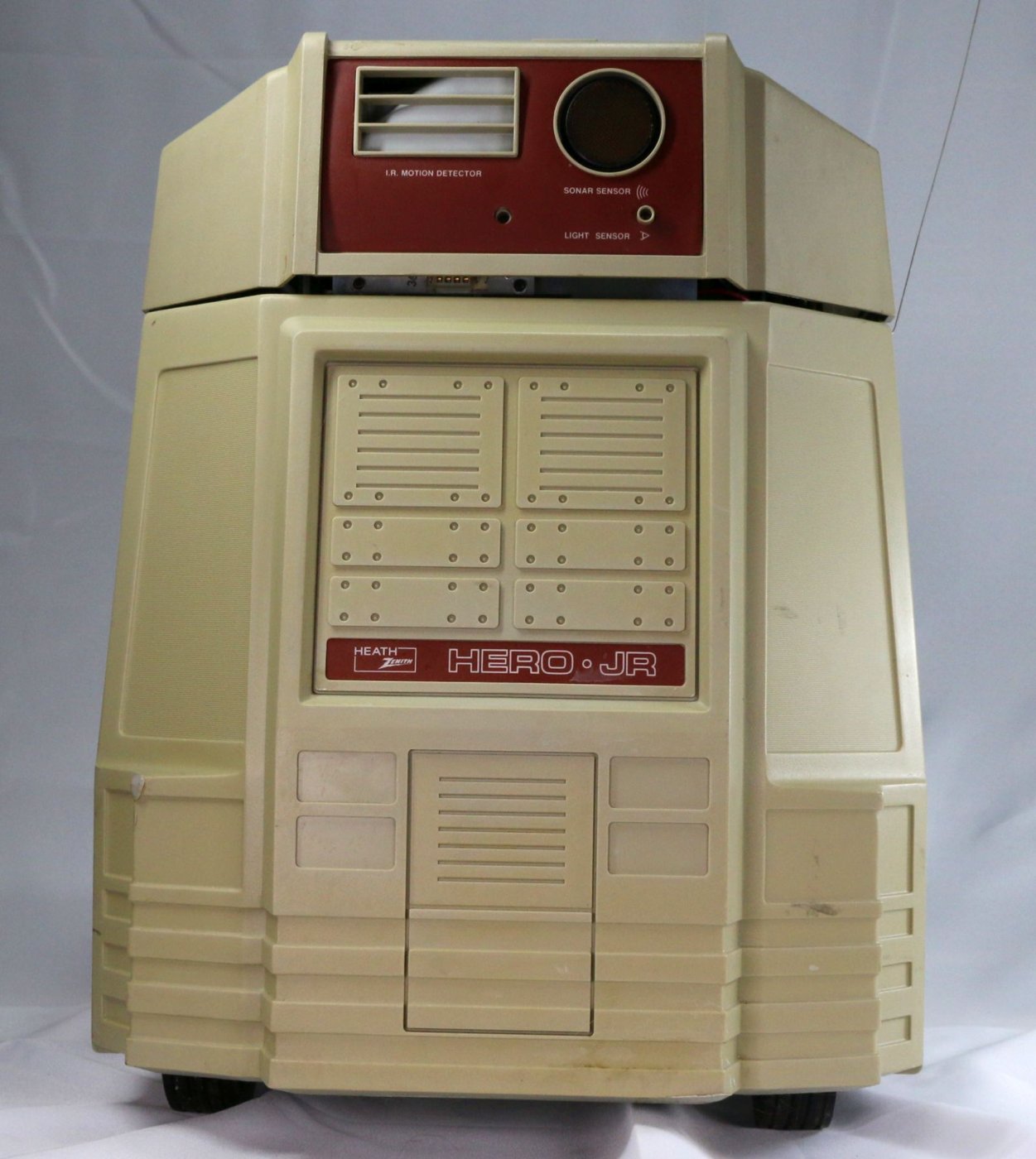
Front-panel labels (I.R. MOTION DETECTOR / SONAR SENSOR / LIGHT SENSOR) are visible on the unit; the fixed head means the sensors aim where the body faces.
9.5 Speech & display
Table 5 — Speech & display
| Item | Value | Source |
|---|---|---|
| Synthesizer | Built-in Votrax SC-01 (SC-01A per Dilettante) | HERO FAQ; Dilettante |
| Method | Phoneme-code stream → continuous formant speech | Votrax SC-01 documentation |
| Display | Nine-LED array; LEDs flash in time with speech (one source says eight) | theoldrobots; HERO FAQ |
Speech is built in on HERO Jr — it was an extra-cost option on the HERO 1.
9.6 Personality keys & programming
Table 6 — Personality keys & programming
| Route | Notes | Source |
|---|---|---|
| Personality keys | One-touch behaviours: Sing, Play, Poet, Gab, Alarm, Guard, Help, Plan (+ Setup, Enter) | theoldrobots; HERO FAQ; Dilettante |
| HJPL | HERO Jr Programming Language — keypad instruction set (interfaces with CPU registers; ~99 per Dilettante) | Dilettante; Programmer’s Guide |
| BASIC | Via the RTC-1-8 cartridge, over a serial RS-232 link | theoldrobots; BASIC manual; Dilettante |
| RF remote | Untethered manual control | Dilettante |
| Input panel | 17-key hex keypad (rubber keys) on the head | theoldrobots; HERO FAQ |
9.7 Cartridge & accessory part numbers
Table 7 — Cartridge & accessory part numbers
| Part # | Type | Source |
|---|---|---|
| RTC-1-1 … RTC-1-11 | Program cartridges (BASIC = RTC-1-8; also games, educational, fitness) | theoldrobots |
| RTA-1-2 | IR motion detector accessory (~35 × 20 ft) | theoldrobots |
| RTA-1-4 | Extra battery pack (doubles capacity) | theoldrobots |
| RTA-1-5 | Cartridge / RAM adapter (+8 KB) | theoldrobots |
Individual RTC-1-x / RTA-1-x titles the record does not name are left unclaimed (see Vol. 7).
9.8 The HERO line, in one row each
Table 8 — The HERO line, in one row each
| Model | Distinguishing spec | Source |
|---|---|---|
| HERO 1 (ET-18) | 6808 @ 1 MHz, 4 KB RAM, optional arm + speech, rotating head | Wikipedia; HERO FAQ |
| HERO Jr (RT-1) | 6808 @ 1 MHz, 2 KB→24 KB RAM, 32 KB ROM, built-in speech, fixed head, no arm, cartridges | HERO FAQ; theoldrobots |
| HERO 2000 | Intel 8088 main CPU, multi-processor, RAM to 576 KB | Wikipedia |
Sources
- HERO Jr Owner’s Guide (RTW-1/RT-1) and Programmer’s Guide (RT-1) —
Internet Archive (
archive.org/details/HEROJrOwnersGuide,archive.org/details/HEROJrProgrammersGuide). Authoritative primaries. - HERO Jr BASIC manual (cartridge RTC-1-8) — the-liberator.net.
- HERO FAQ —
hero.dsavage.net(deepest technical secondary). - theoldrobots.com/herojr.html — specs + cartridge/accessory listing.
- Wikipedia — “HERO (robot)”. Dilettante — partofthething.com firsthand retrospective. astrorat — supporting.
- Votrax SC-01 documentation — general phoneme-synthesizer facts (Vol. 5).
See _shared/comparison.md for the full cross-robot matrix and _shared/safety.md
for the battery and mains-charger cautions referenced in Vol. 8.
Comments (0)