RoboDog · Volume 7
Build 3: The Full-CNC Heavy-Duty Finale
Build 1 proved that a robot can walk. Build 2 proved that the same builder can trot dynamically and navigate autonomously on flat hardscape. Build 3 is the design that both of those tiers were preparing for: a full-size Labrador-scale quadruped machined almost entirely from aluminum, sealed to IP67, capable of unsupervised all-weather patrol across outdoor terrain including slopes and stairs, with autonomous return to a charging dock and a modular structural back deck for bolt-on payloads. The bill of materials for this build is deliberately and honestly stated at approximately US $21,000 — roughly the cost of a mid-tier commercial research platform. That price is not an obstacle to be apologized for; it is the honest cost of what the machine is designed to do. Every dollar is traceable to a specific capability that Builds 1 and 2 could not provide.
7.1 Goal — the Real Security Dog
The stated mission throughout this program has been autonomous all-weather property patrol: a robot that navigates the owner’s property without operator intervention, identifies and alerts on intrusion events, operates through rain, cold, and darkness, runs a repeating patrol schedule across multiple days, and returns to a charging dock when its battery is low — all without human supervision between patrol cycles. Builds 1 and 2 achieved earlier milestones on the way to that goal. Build 1 validated that the owner can assemble, wire, and software-commission a twelve-degree-of-freedom quadruped that walks. Build 2 validated that the same owner can specify, machine, and tune a dynamically trotting QDD-actuated platform with on-board AI compute — the hardest mechanical and software challenge in the build ladder. Build 3 closes the remaining gap between capability and mission.
The specific capability additions that distinguish Build 3 from Build 2:
Full autonomous patrol. Build 2 follows waypoints with assistance from the operator to initiate each session. Build 3 executes a scheduled patrol routine from boot, integrates a real-time kinematic GPS receiver for geodetically anchored waypoint navigation, and makes independent path-planning decisions for the duration of the patrol mission.
All-weather operation. Build 2 tolerates light drizzle. Build 3 targets IP67 sealing throughout — connectors, actuator cable exits, enclosure, and foot-traction surfaces — enabling continuous operation in sustained rain, morning frost, and light snow cover, down to −20°C ambient.
Stair and slope navigation. Build 2 is sized for flat hardscape. Build 3’s torque budget (worked out below) is driven by the stair-climbing requirement: the machine must negotiate standard residential stairs without exceeding the actuators’ design torque envelope at a safety factor of 2.5.
Auto-return and auto-charge. Build 2’s runtime ends when the battery is exhausted and an operator swaps it. Build 3 monitors battery state-of-charge, initiates a return-to-dock behavior at a configurable threshold, executes a precision docking approach using AprilTag-guided navigation, and begins charging autonomously.
Modular payload back. The structural spine is designed as a payload rail with standardized mounting bosses so that antennas, upgraded cameras, chemical detectors, or an airsoft payload module can bolt onto the back deck without modifying the chassis.
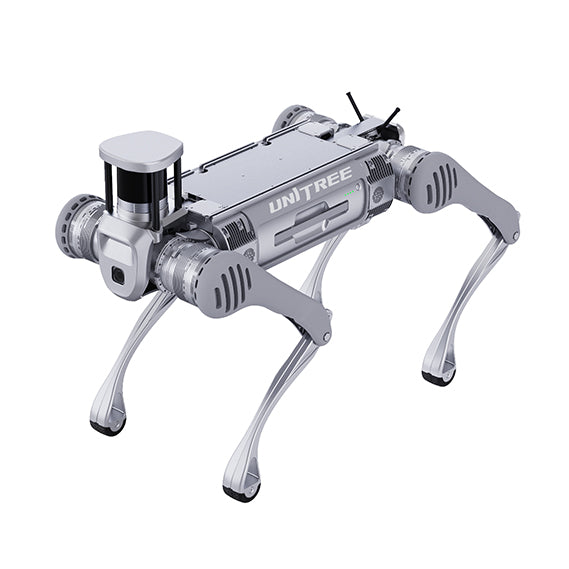
Boston Dynamics Spot is the commercial benchmark for this capability class: IP54, −20°C to +55°C, 90-minute runtime, 14 kg payload, field-deployed across industrial sites globally. [4] The Unitree B2 extends that envelope: IP67, 60 kg, 40 kg payload, 4+ hours runtime, 6.0 m/s. [26] Build 3 targets a similar capability profile at Labrador scale (~30 kg) using open-source software and a machinist’s skill set in place of commercial integration.
7.2 Size and Torque Budget
7.2.1 Mass Budget and Labrador-Scale Justification
A standard adult Labrador Retriever stands 546–622 mm at the shoulder (21½–24½ in at the withers across sexes per the AKC Official Breed Standard; females 546–597 mm, males 572–622 mm) and weighs 25–36 kg. [29] Build 3 targets a hip height of approximately 500 mm and a total machine mass of approximately 30 kg — at the mid-point of that species range. (Note: canine withers height, measured at the highest point of the shoulder blades on a standing dog, and the robot’s hip-height specification, measured from the hip-pivot to the ground, are different measurement conventions; the 500 mm figure is the hip-pivot height and does not imply a sub-Labrador-size machine.) The 30 kg figure is justified by the following component mass budget:
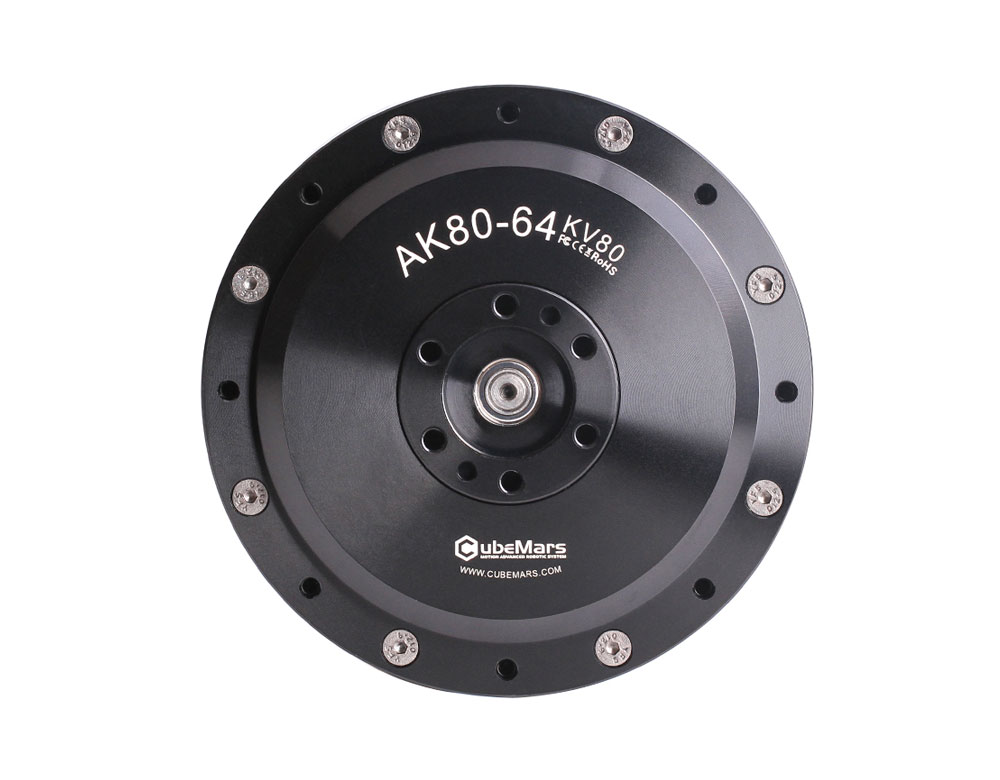
- 12× CubeMars AK80-64 actuators at 850 g each [1]: 10.2 kg
- Full machined 7075-T6 aluminum frame (spine rails, shoulder plates, femur links, tibia links, pivot blocks, payload deck): 5.5 kg (est., based on 6061-T6 frame experience in Build 2)
- Jetson AGX Orin 64GB developer kit (module + carrier board): 0.9 kg (est.)
- 12S LiPo 44.4V 20,000 mAh pack: 5.5 kg (est., based on Tattu 12S 10,000 mAh at 2,800 g scaled for 2× capacity)
- Livox Mid-360 3D LiDAR: 0.265 kg [10]
- OAK-D Pro depth camera, PureThermal 3 + Lepton 3.5 module, ArduSimple RTK board: 0.6 kg (est.)
- IP67 electronics enclosure, sealed wiring harness, cable glands, power distribution: 2.0 kg (est.)
- Payload back deck and mount hardware: 2.0 kg (est.)
- Sealed bearings, stainless fasteners, foot pads, silicone potting: 1.5 kg (est.)
- Miscellaneous wiring, connectors, PCBs: 1.5 kg (est.)
Total mass budget: ~29.9 kg → 30 kg
The 30 kg total is greater than Build 2’s 10 kg because the actuators are heavier (850 g vs. 490 g each), the battery capacity is doubled, and the fully machined aluminum frame and IP67 sealing components add mass that Build 2’s PETG-CF hybrid structure avoided. For comparison, Boston Dynamics Spot weighs 32.7 kg [4] and the Unitree B2 weighs 60 kg [26]; the Build 3 target sits between these commercial references at a scale appropriate to the Labrador-size objective.
7.2.2 Stair-Climbing Torque Budget
Static body-weight support in a four-leg stance is the minimum joint torque requirement, not the design target. Stair climbing adds two compounding demands: (a) the number of legs in contact with the stair surface during the step-over phase is reduced from four to two or transiently one, increasing the per-leg load; and (b) the climbing pose places the knee joint at maximum flexion, which maximizes the moment arm from the joint pivot to the foot contact point, increasing joint torque at a given load. The following analysis quantifies both effects.
Assumptions and geometry:
Table 1 — Assumptions and geometry:
| Parameter | Symbol | Value | Basis |
|---|---|---|---|
| Total machine mass | M | 30 kg | Mass budget above |
| Gravitational acceleration | g | 9.81 m/s² | Standard |
| Femur length (hip pivot to knee joint) | L_f | 0.22 m | Lab-scale upper leg; same as Build 2 |
| Tibia length (knee joint to foot contact) | L_t | 0.20 m | Lab-scale lower leg; 33 mm longer than Build 2’s 0.15 m |
| Stair riser height | h | 0.190 m | Standard residential stair (IRC §R311.7.5 max 7.75 in = 0.197 m) |
| Stair tread depth | d | 0.280 m | IRC §R311.7.5 minimum 10 in = 0.254 m; use 280 mm as typical |
| Stance-leg count, 4-leg static | N₄ | 4 | Baseline reference only |
| Stance-leg count, climbing gait | N₂ | 2 | Two diagonally opposite legs in contact during stair negotiation |
| Stance-leg count, peak transient | N₁ | 1 | Single-leg push-off at step edge — brief absolute worst-case |
| Safety factor | SF | 2.5 | Increased from Build 2’s 2.0; accounts for outdoor dynamic impact events |
Calculation — step by step:
Step 1: Four-leg static floor (the floor, not the design value) Per-leg force: F_v,4 = Mg/4 = (30 × 9.81)/4 = 73.6 N In normal standing pose the tibia is approximately 20° from vertical; effective knee moment arm: 0.20 × sin(20°) = 0.068 m τ_knee,4 = 73.6 × 0.068 = 5.0 N·m — the static floor.
Step 2: Diagonal trot, two-leg stance, end of stance phase (tibia at ~30° from vertical) Per-leg force: F_v,2 = Mg/2 = 147.2 N Effective knee arm at 30° from vertical: 0.20 × sin(30°) = 0.100 m τ_knee,2,flat = 147.2 × 0.100 = 14.7 N·m — trot gait reference.
Step 3: Stair climbing, two-leg stance, maximum knee flexion (tibia approaches horizontal) At the top of the push-off to mount a stair, the tibia approaches horizontal, maximizing the moment arm: L_eff,k = L_t = 0.20 m τ_knee,2,climb = F_v,2 × L_eff,k = 147.2 × 0.20 = 29.4 N·m
At the hip joint, the femur is at approximately 45° from horizontal during the push-off pose: L_eff,h = L_f × cos(45°) = 0.22 × 0.707 = 0.155 m τ_hip,2,climb = 147.2 × 0.155 = 22.8 N·m
Step 4: Single-leg peak transient (N₁ = 1, tibia horizontal) During the instant of step-over when a single foreleg is in contact at the tread edge: F_v,1 = Mg/1 = 294.3 N τ_knee,1 = 294.3 × 0.20 = 58.9 N·m (no safety factor; this is a brief spike)
Step 5: Apply safety factor SF = 2.5 to the N₂ design case τ_req,knee = 29.4 × 2.5 = 73.5 N·m ← actuator torque requirement τ_req,hip = 22.8 × 2.5 = 57.0 N·m
Summary table:
Table 2 — Summary table:
| Input / Intermediate / Result | Symbol | Value | Notes |
|---|---|---|---|
| Total mass | M | 30 kg | Justified mass budget |
| Femur length | L_f | 0.22 m | Hip to knee |
| Tibia length | L_t | 0.20 m | Knee to foot |
| Stair riser | h | 0.190 m | IRC residential standard |
| Stance legs, climbing | N₂ | 2 | Diagonal pair in contact |
| Per-leg force, N₂ | F_v,2 | 147.2 N | Mg / 2 = (30 × 9.81) / 2 |
| Knee moment arm, max flexion | L_eff,k | 0.20 m | Tibia horizontal = worst case |
| Hip moment arm, femur at 45° | L_eff,h | 0.155 m | L_f × cos(45°) |
| Knee torque, N₂ climbing | τ_k,climb | 29.4 N·m | 147.2 × 0.20 |
| Hip torque, N₂ climbing | τ_h,climb | 22.8 N·m | 147.2 × 0.155 |
| Safety factor | SF | 2.5 | Dynamic outdoor, stair environment |
| Required knee torque (N₂, SF=2.5) | τ_req,k | 73.5 N·m | 29.4 × 2.5 ← design target |
| Required hip torque (N₂, SF=2.5) | τ_req,h | 57.0 N·m | 22.8 × 2.5 |
| Single-leg peak transient (N₁, no SF) | τ_k,1 | 58.9 N·m | 294.3 × 0.20 — brief spike |
| AK80-64 peak torque [1] | — | 120 N·m | CubeMars datasheet |
| AK80-64 rated torque [1] | — | 48 N·m | CubeMars datasheet |
| Peak margin, N₂ design case | — | 1.63× | 120 / 73.5 → actuator PASSES |
| Peak margin, N₁ transient (no SF) | — | 2.04× | 120 / 58.9 → also PASSES |
Sanity check against real machines. The MIT Mini-Cheetah (9 kg, 17 N·m peak actuators [5]) operated at a ratio of roughly 1.9 N·m of actuator peak per kg of body mass. At 30 kg, that ratio implies 57 N·m — consistent with this analysis’s 73.5 N·m design target (the larger value reflects the climbing-specific load case, not flat-ground trot). Boston Dynamics Spot’s joint actuators are not publicly specified, but engineering community reverse-engineering estimates place peak joint torque in the 50–100 N·m range for a 32.7 kg machine [4], again consistent with the result. The AK80-64’s 120 N·m peak passes the N₂ design case with a 1.63× peak margin. The 73.5 N·m design case is approximately 1.53× above the AK80-64’s 48 N·m rated continuous torque [1]; stair climbing must be treated as a duty-cycle-limited burst condition, not a continuous-load case — sustained operation above the 48 N·m continuous rating would thermally limit the actuators over extended stair sequences. This is acceptable for the patrol mission, where stair negotiation is a brief gait event rather than a sustained duty mode. This is a first-order static estimate only; a real design iteration should validate with dynamic simulation (e.g., Isaac Lab or MuJoCo) before finalizing the actuator selection.
7.3 Actuators
7.3.1 CubeMars AK80-64 KV80 — 120 N·m Peak at 64:1 Reduction
The CubeMars AK80-64 KV80 is the actuator specified for Build 3. It integrates an 80-class brushless DC motor, a 64:1 single-stage planetary gearbox, a 14-bit magnetic absolute encoder, and an FOC driver board into a Ø98 × 61.9 mm housing weighing 850 g. [1] Published specifications from the CubeMars product page (accessed June 2026) list peak torque at 120 N·m, rated continuous torque at 48 N·m, rated voltage at 24/48 V, rated current at 7 A, and peak current at 19 A. [1] No-load speed at 48 V is 75 rpm (rated speed 48 rpm). Operating temperature spans −20°C to 50°C. Control interface is CAN bus with servo and MIT hybrid modes supported. [1] Unit price is US $889.90 from the CubeMars product page; the store.cubemars.com online store is the direct procurement channel. [1][2]
The step-up from Build 2’s AK80-9 V3.0 (22 N·m peak, 490 g, US $479.90 [3]) to the AK80-64 is driven entirely by the torque budget above. At 30 kg and SF = 2.5 for stair climbing, the required knee torque is 73.5 N·m — more than three times what the AK80-9 can deliver at its 22 N·m peak. The AK80-64 achieves its 5.5× torque multiple over the AK80-9 through an increase in gear ratio from 9:1 to 64:1 on the same motor frame diameter, at the cost of lower output speed (75 rpm vs. 570 rpm no-load) and roughly double the mass per joint.
The 64:1 ratio is meaningfully higher than the QDD design rationale that animates the AK80-9 class. At 64:1, backdrivability — the ability of an external force to push the joint back — is reduced compared to a 9:1 ratio. The AK80-64 is not a fully quasi-direct-drive actuator in the MIT Cheetah sense; it is closer to a high-reduction servo module. For the Build 3 patrol mission (controlled-speed outdoor locomotion rather than athletic jumping or impact-absorbing bounding), this is an acceptable trade: the machine needs to negotiate stairs and slopes at walking speed, not absorb high-impulse landings from jumps. The torque capacity is the dominant constraint; backdrivability is secondary.
7.3.2 Sealing Strategy — No Native IP Rating
The AK80-64 carries no published IP rating. [1] Its motor windings and electronics are enclosed in a machined aluminum housing, and the operating temperature range confirms it is not inherently moisture-vulnerable, but the standard shipping configuration does not seal the cable exit ports or the gearbox vent path for water intrusion. For the IP67 target of Build 3, the following sealing protocol applies at each joint:
Cable exits: Each actuator has a CAN/power connector (XT30 + 4-pin JST). These exits are potted in two-part marine-grade silicone (Dow Corning 3145 RTV or equivalent) during final assembly, with Amphenol Ecomate or Switchcraft IP67-rated cable glands used where connectors must be de-matable in the field.
Gearbox output face: A custom-machined aluminum cover plate with a Gore-style ePTFE membrane vent (which allows pressure equalization while blocking liquid) seals the gearbox output shaft bore. An NBR O-ring on the cover plate seats against the actuator face.
Bearing preload screws: All external fasteners on the actuator housing are sealed with removable thread-locker and silicone gasket compound.
This per-actuator sealing protocol adds approximately US $15 per joint in materials (potting compound, glands, cover, O-ring) — not separately itemized in the BOM, but within the silicone potting line item.
7.4 Structure
7.4.1 Fully Machined 7075-T6 Aluminum
Build 2’s mixed PETG-CF and machined 6061-T6 architecture is appropriate for a 22 N·m/joint system without a full IP sealing requirement. At 120 N·m per joint and IP67 throughout, every structural member is machined from aluminum billet. Build 3 uses 7075-T6 (yield strength 503 MPa [30], approximately 1.8× Build 2’s 6061-T6 at 276 MPa [31]) for the highest-stress members:
- Shoulder side plates and hip pivot blocks: These transfer the full 120 N·m peak actuator moment into the chassis spine. At 7075-T6 with a minimum wall thickness of 4 mm at the critical section, the bending stress remains below 40% of yield — comfortable margin.
- Femur and tibia link members: Hollow rectangular section, 20×30 mm OD with 2 mm walls, machined from bar stock. CAN/power cable bundle routes through the hollow bore in a braided stainless mesh sleeve for abrasion protection.
- Spine structural rails: 30×40 mm rectangular tube, two rails in parallel forming the body backbone, drilled and tapped with 8× M6 boss pairs on 50 mm centers for payload mounting. Rail length matches the Labrador-scale body.
- Foot-pad carrier blocks: Machined from 6061-T6 (lower stress at distal end); accepts 50-durometer urethane pad press-fit, replaceable without tools by removing two M4 bolts.
6061-T6 is retained for less critically loaded structural covers, electronics enclosure lid, and secondary brackets.
7.4.2 IP67 Joint Sealing
Every rotating joint carries a sealed ABEC-5 bearing (2RS designation, stainless-shielded) press-fit into the aluminum pivot block. The 2RS double rubber seal is rated to IP67 equivalent for low-speed rotation (the bearing standards define contact seal effectiveness above 1 m/s peripheral speed; at the 75 rpm maximum output speed of the AK80-64, peripheral speed at a 30 mm bore radius is approximately 0.24 m/s — the 2RS seal provides effective sealing against dust and moisture ingress at this speed). All pivot block bore-to-actuator housing interfaces carry a silicone face gasket, and fasteners are M5 stainless A4-80 with O-ring washers.
7.4.3 Foot Design and Traction
The foot-pad carrier at the distal end of each tibia accepts a 50 mm-diameter × 8 mm-thick urethane pad (50 Shore A). Urethane provides wet-surface traction comparable to rubber compounds and is chemically resistant to frost-melt road salt and lawn treatment chemicals. [32] Below the urethane, a 12 mm-diameter stainless sphere (the foot-tip) provides a defined contact point geometry for the inverse-kinematics foot-position model. The sphere and urethane are replaced as a cartridge; no tools are needed beyond a standard M4 hex key.
7.5 Compute
7.5.1 Jetson AGX Orin 64GB — 275 TOPS, All-Weather
The Jetson AGX Orin 64GB developer kit provides 275 TOPS of AI inference performance from its 2048-core NVIDIA Ampere GPU, 12-core ARM Cortex-A78AE CPU, and dual deep-learning accelerators (DLAs), in a power envelope configurable between 15 W and 60 W. [6][7] The developer kit (module + reference carrier board) is priced at US $1,999 from authorized distributors including SparkFun, Seeed Studio, and Amazon as of June 2026. [6] Operating temperature spans −25°C to 80°C for the standard module — the bottom of that range covers the −20°C outdoor cold-weather operating target for Build 3 with 5°C margin. [8][9] The module-only variant (without carrier board) is priced at approximately US $1,599, but the developer kit is used here because the reference carrier board includes the full port complement needed for the Build 3 sensor set (2× GbE, USB 3.2, HDMI for bench debug, 2× CSI camera, and M.2 slots for SSD and WiFi) without a custom-board design effort.
The upgrade from Build 2’s Jetson Orin NX 16GB (100 TOPS) to the AGX Orin 64GB (275 TOPS) is driven by the concurrent inference workloads of the full autonomy stack: (a) LiDAR-SLAM at 10 Hz on 200,000-point/s Livox Mid-360 cloud; (b) OAK-D Pro depth-image object detection at 30 fps; (c) PureThermal thermal-image analysis pipeline; (d) Nav2 path planning with RTK-GPS costmap integration; and (e) the security-event classifier (person vs. animal vs. vehicle) that constitutes the machine’s principal on-board AI function. At 100 TOPS, the Orin NX handles (b) comfortably and (d) adequately; (a), (c), and (e) together exceed its headroom in sustained operation. At 275 TOPS, the AGX Orin 64GB handles all five concurrently with headroom for future model additions.
7.5.2 Real-Time Motor Control MCU
The STM32G4 Nucleo-G474RE remains the real-time substrate for the joint control loop, running micro-ROS at 10–15 kHz CAN-FD update rate — identical to Build 2’s architecture. [21] The AGX Orin’s Linux kernel cannot guarantee sub-millisecond timing for the 12-joint CAN bus loop; the STM32G4 decouples gait timing from the application processor. The MCU subscribes to joint torque and position targets published by the CHAMP locomotion controller on the Orin [20] and translates them to CAN-FD frames for each AK80-64 node ID.
7.6 Full Autonomy
Build 2’s assisted autonomy required an operator to initiate each patrol session and monitor the run. Build 3 targets unsupervised operation: the machine executes a programmed patrol schedule from a boot-time ROS 2 launch file, navigates via GPS waypoints anchored to absolute geodetic coordinates, makes autonomous obstacle-avoidance decisions using the LiDAR and depth-camera costmap, and returns to the charging dock when battery state-of-charge falls below a configurable threshold.
7.6.1 ROS 2 and CHAMP Locomotion
The locomotion controller is CHAMP running in torque-mode impedance control, unchanged from Build 2. [20] On the AK80-64’s 64:1 gear ratio, the gait frequency ceiling is lower than on Build 2’s AK80-9 (75 rpm vs. 570 rpm output): maximum no-load tibia angular velocity at 75 rpm is approximately 7.9 rad/s, allowing a foot-contact cycle time of approximately 0.4 s — adequate for a 1.0–1.5 m/s patrol walking speed. Trotting at higher speed requires velocity-mode control at reduced torque; the 48 N·m rated torque remains available under velocity mode. The CHAMP URDF is updated with the AK80-64’s gear ratio, output inertia, and the new tibia length of 0.20 m.
7.6.2 GPS Waypoint Navigation with RTK
Build 2’s Nav2 integration uses a 2D occupancy costmap derived from the RPLIDAR S2 scan and a 3D costmap from the OAK-D Pro depth stream. Build 3 adds a geodetically anchored global frame using the ArduSimple simpleRTK2B RTK GNSS receiver (u-blox ZED-F9P chip). [16][17] RTK correction from a nearby NTRIP base station or a local reference station on the property delivers horizontal position accuracy of less than 2 cm — sufficient to anchor patrol waypoints to real-world coordinates that survive robot power cycles. [28] Without RTK (or if the RTK fix degrades), the system falls back to standard GNSS (1–3 m accuracy) and continues navigating from the LiDAR-SLAM map; waypoint fidelity degrades but the robot remains functional. The ublox_ros2_driver package publishes sensor_msgs/NavSatFix messages that the Nav2 global costmap transforms from WGS84 to the local map frame via the robot_localization EKF node fusing GNSS, IMU, and LiDAR odometry. [19]
7.6.3 Security Event Classification
The AGX Orin’s GPU inference capacity supports a concurrent YOLO-class object-detection model fine-tuned on the four-class problem the patrol mission requires: person, animal (dog/deer), vehicle, and background. The OAK-D Pro’s VPU handles the primary detection pass (as in Build 2); the Orin GPU runs a secondary classification pass on detections that exceed a confidence threshold to reduce false-positive alerts. Confirmed security events are timestamped with GPS coordinates and published to a local MQTT broker, which can forward to a home-automation system or a mobile notification push.
7.6.4 Autonomous Return-to-Dock
At a configurable battery SOC threshold (default 20%), the Nav2 waypoint follower interrupts the current patrol route and navigates to the dock location. The dock approach uses a two-phase strategy: (1) Nav2 path planning to within 2 m of the dock using the GNSS anchor and LiDAR costmap; (2) a precision dock-align action server that switches to the OAK-D Pro and an AprilTag detector to achieve sub-50 mm alignment for contact pad engagement. The dock action server is modeled on the Nav2 Dock Server behavior-tree plugin introduced in Nav2 Humble. [19] The robot holds position at the dock until the battery SOC exceeds 80%, then re-executes the patrol launch file.
7.7 Vision
7.7.1 3D LiDAR: Livox Mid-360
The Livox Mid-360 is the primary terrain-mapping sensor for Build 3. Its 360° × 59° (vertical −7° to +52°) field of view provides full-hemisphere coverage including the ground plane immediately in front of the robot and the forward mid-range terrain at up to 40 m (10% reflectivity target) and 70 m (80% reflectivity target). [10] The IP67 rating, −20°C to 55°C operating range, and built-in ICM-40609 IMU make it the correct sensor for the all-weather patrol mission. Point output is 200,000 points per second (first return); the built-in non-repetitive scan pattern ensures that the full FOV is covered within 0.1 s rather than a fixed line scan, which is important for the low-speed walking gait where the robot may sweep through a heading change before a next scan line arrives. [10]
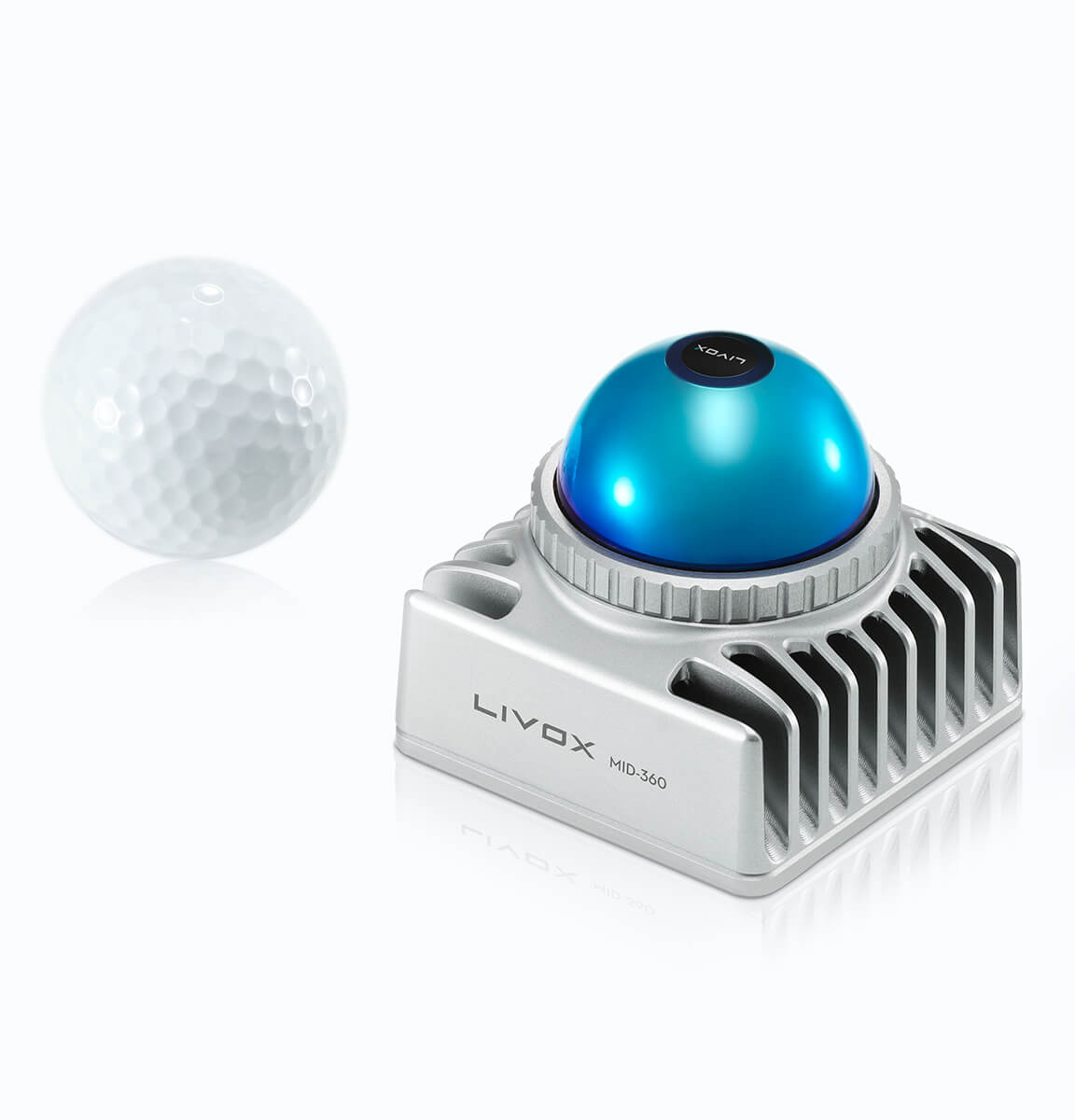
US distributor price for the Livox Mid-360 as of June 2026 is US $4,275 from RoboStore [11] and STEMfinity [12] — both US distributors confirm the same price. This is substantially higher than the approximately US $749 figure cited in Volume 4’s Tier-3 planning section (which reflected a then-current livoxtech.com factory pricing indication); builders planning this build should use the confirmed US distributor price of $4,275 for procurement planning. The Mid-360 uses a 100BASE-TX Ethernet interface with IEEE 1588-2008 PTPv2 time synchronization, interfacing to the Orin’s GbE port through a compact switch that also connects the RTK GNSS receiver.
The Mid-360’s self-heating mode draws up to 14 W peak (versus 6.5 W average) to maintain accurate ranging below 0°C; the power budget must account for this peak draw on the 12 V compute rail.
7.7.2 Stereo Depth: Luxonis OAK-D Pro
The Luxonis OAK-D Pro (US $429 [15]) carries forward from Build 2 without change. Its 4 TOPS Intel Myriad X VPU handles the primary object-detection pipeline without loading the AGX Orin GPU, and its IR dot projector and IR LED enable depth imaging and active night illumination independently of the LiDAR. The OAK-D Pro’s 70 cm–12 m stereo depth range covers the 0–5 m zone that the LiDAR’s minimum 0.1 m detection distance and non-repetitive pattern do not densely populate at very short range.
7.7.3 Thermal IR: PureThermal 3 + FLIR Lepton 3.5
Night and low-visibility patrol require a sensor that detects warm-body (person or large animal) presence when optical cameras are blind. The FLIR Lepton 3.5 is an 160 × 120 pixel LWIR microbolometer module operating in the 8–14 μm band, sensitive to temperature differences as small as 0.05°C, with a 57° diagonal FOV. [13] Mounted on a PureThermal 3 carrier board (US $199.99 [14]) — which provides USB 2.0 UVC interface, an STM32F412 host controller, and a standard USB-A connector — the combined assembly (PureThermal 3 + Lepton 3.5 upgrade module, total approximately US $250 [13][14]) appears as a standard UVC camera to the Jetson AGX Orin and is addressed in ROS 2 via the v4l2_camera driver without additional middleware. The 160 × 120 thermal image is fused with the OAK-D Pro RGB stream using a camera_calibration transformation to overlay thermal blobs on the RGB frame for the security classifier.
For patrol applications requiring higher thermal resolution — distinguishing a person from a dog at 50 m, for example — the FLIR Boson+ is the upgrade option: 320 × 256 or 640 × 512 LWIR at full outdoor ruggedization, priced at US $1,923–$2,412 depending on configuration. [27] At roughly 8–10× the cost of the Lepton assembly, the Boson+ is specified here as an optional upgrade rather than a base-build component.
7.8 Power and Thermal Management
7.8.1 Battery: 12S LiPo at 44.4 V Nominal, 20,000 mAh
The same 12S lithium polymer bus voltage used in Build 2 (44.4 V nominal, 50.4 V fully charged) is retained for Build 3. The AK80-64 is rated for 24/48 V operation; at 12S the bus voltage is within the rated envelope, and the 12S chemistry and cell count provide a good balance of energy density and cell management complexity. Capacity is doubled from Build 2’s 10,000 mAh to 20,000 mAh (888 Wh) to meet the longer patrol-runtime requirement.
Build 3 power draw estimate (12× AK80-64 at 7 A rated × 44.4 V = 3,729 W worst case; at 20–25% average actuator loading for a walking patrol gait, average actuator draw ≈ 740–930 W; add compute at ~60 W and sensors at ~35 W): estimated system average of approximately 850–1,025 W during active patrol. At 888 Wh and 85% depth of discharge, usable energy is approximately 755 Wh. Runtime estimate: 755 / ((850 + 1,025) / 2) = 755 / 937 ≈ 0.81 hours at the midpoint estimate, or approximately 44–53 minutes of active patrol before triggering the 20% SOC return threshold. Terrain difficulty, gait aggressiveness, and thermal load all affect this figure; the 20% SOC return threshold effectively extends usable patrol time since the battery is not run to depletion.
The battery pack estimate of approximately US $895 (twice the Build 2 Tattu 10,000 mAh at $467.62 plus a margin for the higher C-rating cell quality expected for sustained patrol use) is marked as an estimate in the BOM; buyers should obtain a current quote from Gens Ace / Tattu or comparable manufacturers at the time of purchase.
7.8.2 Power Rail Architecture
Three rails derive from the 44.4 V traction bus:
44.4 V traction rail — feeds all twelve AK80-64 actuators through a fused distribution board with per-actuator 20 A blade fuses. The MOSFET soft-start relay from Build 2 is retained and upgraded to a 100 A-rated relay to handle the higher inrush of twelve AK80-64 actuators at 19 A peak current each.
12 V compute + sensor rail — synchronous buck converter (48→12 V, 10 A minimum), feeds the AGX Orin dev kit, Livox Mid-360, OAK-D Pro, PureThermal 3, and RTK GNSS receiver. The Livox Mid-360’s 14 W cold-weather peak draw sets the rail sizing floor at this branch. Converter efficiency target >92%.
5 V logic rail — stepped down from 12 V via a linear LDO (simpler than a second switcher at this current level), feeds the STM32G4 MCU, BMI088 IMU, USB-CAN adapter, and LED status indicators.
7.8.3 Cold-Weather Operation
The AK80-64 is rated to −20°C operation [1] and the Jetson AGX Orin to −25°C. [9] The primary cold-weather vulnerability is the 12S LiPo pack: lithium polymer cells lose approximately 20% of rated capacity at 0°C and 40–50% at −20°C. [25] To maintain usable runtime in cold conditions:
A 50 W PTC (positive temperature coefficient) silicone heating pad is wrapped around the battery pack and thermostated at 15°C minimum surface temperature. The PTC heater draws from the 12 V compute rail before the traction rail is enabled; the boot sequence holds actuator power off until the heater controller reports battery surface temperature above 10°C (approximately 90–180 seconds of warm-up in −10°C ambient). This strategy is analogous to standard cold-weather practice for UAV LiPo packs. [25] At −20°C with the heater maintaining 10°C surface temperature, capacity loss is estimated at 15–20% rather than 40–50%, extending usable patrol time proportionally.
7.9 Weatherproofing
7.9.1 IP67 Design Target
Build 3 targets IEC 60529 IP67: complete dust exclusion (first digit 6) and protection against temporary immersion to 1 m depth for up to 30 minutes (second digit 7). For a ground-patrol robot, 1 m immersion depth covers operation through standing water, puddles, and stream crossings up to hip height. For comparison, Boston Dynamics Spot is rated IP54 [4] (dust protection but no immersion protection; directional water jet resistance only), the Unitree B2 [26] and DEEP Robotics X30 Pro [33] are rated IP67. Build 3’s IP67 target matches the industrial standard for all-weather autonomous outdoor machines, not the lighter-duty IP54 standard of Spot.
The IP67 design strategy is implemented at five layers:
1. Sealed bearings at every rotating joint — 2RS-shielded ABEC-5 bearings at all pivot points (see Structure section). These provide effective dust and moisture sealing at Build 3’s operating speeds.
2. Actuator cable-exit potting — Marine-grade silicone potting at each CAN/power cable exit on the AK80-64 housing. IP67 Amphenol Ecomate connectors at any interface that must be field-demated (battery disconnect, dock charging contacts).
3. Spine electronics bay — The Orin dev kit, STM32G4, power distribution board, and DC-DC converters are housed in a custom machined 6061-T6 enclosure with an O-ring-sealed lid. Connector pass-throughs use IP67-rated cable gland fittings rated to 10 bar differential. The enclosure lid is secured with six M4 captive screws and a nitrile O-ring.
4. Sensor apertures — The Livox Mid-360 is IP67-rated in its base configuration. [10] The OAK-D Pro and PureThermal 3 assembly are housed in a secondary sealed polycarbonate dome on the front of the spine; the dome attaches with a silicone gasket and six M3 screws.
5. Wiring harness through-limb routing — CAN and power cables route through hollow leg link members and exit through O-ring-sealed bores. No external cable runs are present in the final build; all interconnects are interior.
At −20°C, silicone gaskets and O-rings retain their seal performance (silicone is rated to −55°C; nitrile to −40°C). PETG-CF is not used in this build; all structural and enclosure members are aluminum, which presents no thermal shrinkage compatibility issues with stainless fasteners at −20°C.
7.10 Auto-Charge Dock
7.10.1 Dock Architecture
The auto-charge dock is a fixed outdoor station that provides the robot with: (a) a precision-alignment target (AprilTag panel); (b) electrical contact charging at the 44.4 V bus voltage; and (c) weatherproof housing for the charger electronics. The Unitree Go2 demonstrated fully autonomous self-charging in field tests published in April 2026, establishing that the end-to-end ROS 2 software stack — battery monitoring, return navigation, precision docking, and charge-complete re-launch — is achievable on a current quadruped platform. [22][23] Boston Dynamics Spot Enterprise includes a commercial docking station that performs the equivalent function at the enterprise tier. [24]
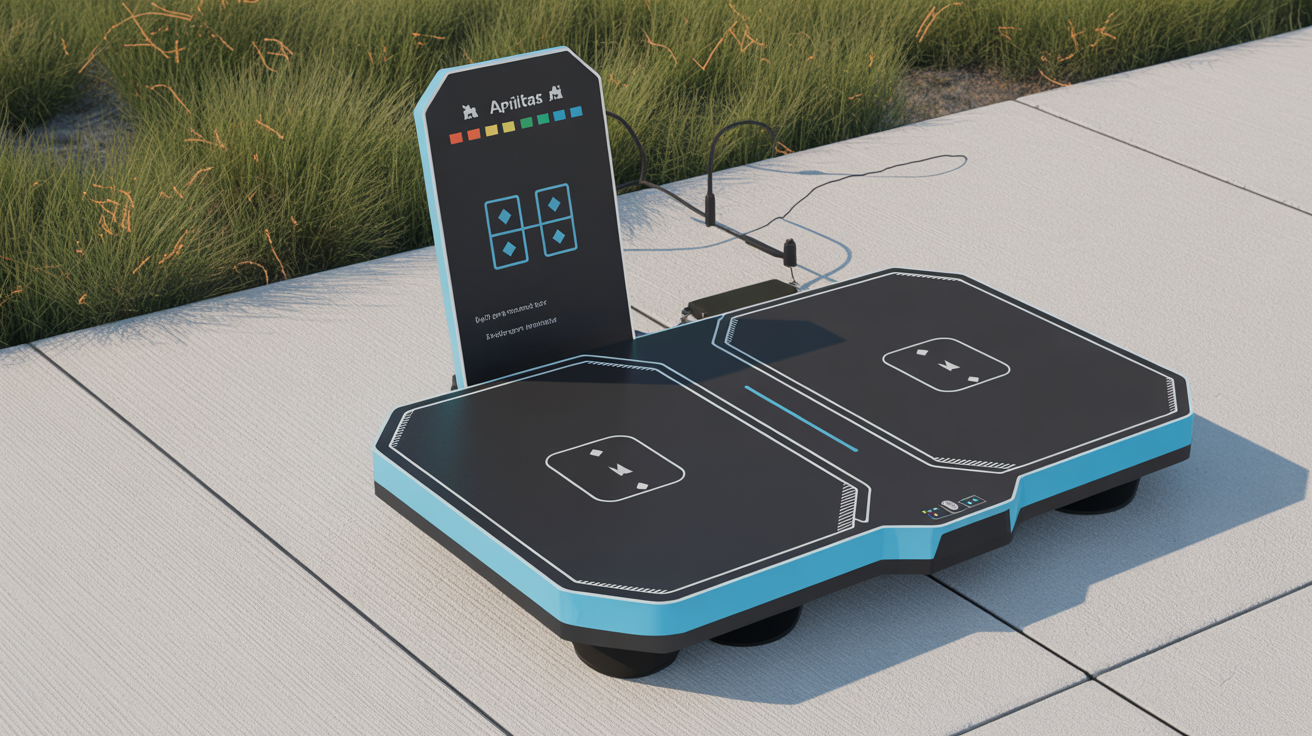
Physical design: The dock is a low-profile weatherproof station approximately 250 × 350 × 80 mm (W × D × H) surface-mounted to a concrete pad at the patrol return point. Two spring-loaded gold-plated contact pads on the forward face engage mating contacts on the robot’s belly undercarriage when the robot walks into position. The contact pads deliver 48 V DC at up to 10 A (480 W maximum charge rate) from an enclosed switching power supply (48 V, 10 A, IP65 enclosure) fed from a standard 120/240 V AC outlet. An AprilTag (ID 0, 200 × 200 mm, printed on weatherproof UV-resistant vinyl laminate) is mounted at a fixed height and distance above the contact pads on a polycarbonate panel, providing the visual fiducial that the robot’s OAK-D Pro uses during the final 2 m approach.
Software:
The nav2_behaviors Dock Server plugin executes the two-phase docking sequence described in the Full Autonomy section. A contact-detection signal (a small shunt current sensor on the dock output) confirms engagement and initiates the charge cycle via a MQTT message to the robot. Charge monitoring is handled by the STM32G4 MCU’s ADC monitoring cell voltage across the balance connector.
Bill of materials for the dock (estimated, included in the main BOM at $400): 48 V 10 A switching PSU enclosure (~$80), spring-loaded gold contact pads ($40), polycarbonate enclosure top ($30), AprilTag panel and bracket ($25), wiring and waterproof outdoor outlet fitting ($50), mounting hardware and anchor bolts ($20), labor (owner’s machining, 2 hours) ($0 machine time). Dock total: approximately $245 in purchased parts + consumables.
7.11 Payload-Back Integration
The spine structural rail is designed from the outset as a payload platform, not an afterthought. The two 30×40 mm rectangular tube backbone members are drilled and tapped on their upper faces with 8× M6 boss pairs on 50 mm centers across a 350 mm load zone, providing 16 M6 mounting threads in a standardized 50 mm grid. Payload maximum static mass is 5 kg (limited by spine bending stress at mid-span); payload maximum dynamic mass for trot-speed operation is 3 kg (limited by inertial loading during gait transitions). Both limits are derived from beam-bending analysis at 276 MPa yield stress (6061-T6 conservative figure) with SF = 2.5.
Electrical integration: two waterproof JST-PH pass-throughs in the spine enclosure lid provide 12 V at 3 A and 5 V at 2 A for payload devices. A USB 3.2 Gen 1 port is routed from the Orin dev kit to a bulkhead connector on the payload rail for high-bandwidth data devices. All pass-throughs are sealed at the spine enclosure interface with O-ring stackups.
Modular payload examples planned for later program phases: (a) a standalone 1080p PTZ surveillance camera for perimeter zoom capability; (b) a long-range 5 GHz directional antenna module extending the WiFi patrol radius; (c) a chemical / smoke sensor array for fire and gas detection integration; (d) the airsoft payload module described in the program’s initial design goals as a modular add-on. Each payload bolts to the M6 grid without structural modification to the chassis.
7.12 Bill of Materials
Prices are US distributor prices as of June 2026. Items marked “est.” are community-derived or cross-referenced estimates without a single authoritative current price source. Every priced cell that is not estimated carries its source reference number. The Total row is the exact arithmetic sum of the Total column; the re-sum is shown below the table.
Table 3 — Bill of Materials
| Component | Qty | Unit (USD) | Total (USD) | Notes |
|---|---|---|---|---|
| CubeMars AK80-64 KV80 robotic actuator | 12 | $889.90 [1] | $10,678.80 | 120 N·m peak; 48 N·m rated; 64:1; 850 g; CAN bus |
| NVIDIA Jetson AGX Orin 64GB developer kit | 1 | $1,999.00 [6] | $1,999.00 | 275 TOPS; 15–60 W; −25°C to 80°C; module + carrier |
| Livox Mid-360 3D LiDAR | 1 | $4,275.00 [11][12] | $4,275.00 | IP67; 360°×59°; 40/70 m; 200k pts/s; 265 g |
| Luxonis OAK-D Pro stereo depth camera | 1 | $429.00 [15] | $429.00 | 4 TOPS VPU; 70 cm–12 m; IR dot projector; IR LED |
| PureThermal 3 board + FLIR Lepton 3.5 module | 1 | $250.00 est. [13][14] | $250.00 | 160×120 LWIR thermal; USB UVC; ROS 2 via v4l2_camera |
| ArduSimple simpleRTK2B Budget (u-blox ZED-F9P) | 1 | $195.00 est. [17] | $195.00 | €172 listed; ~US $195 at June 2026 exchange; <2 cm RTK |
| Grove BMI088 6-axis IMU breakout | 1 | $28.00 [18] | $28.00 | Vibration-characterized; I2C/SPI; Build 2 carryover |
| STM32G4 Nucleo-G474RE dev board (real-time loop) | 1 | $25.00 est. | $25.00 | micro-ROS; 170 MHz; CAN-FD; real-time gait loop |
| CANable Pro USB-CAN-FD adapter | 1 | $30.00 est. | $30.00 | CAN-FD bus bring-up/debug interface |
| 12S LiPo 44.4 V 20,000 mAh 30C | 1 | $895.00 est. | $895.00 | ~888 Wh; basis: Tattu 10 Ah at $468 × 2 + margin |
| 12S LiPo balance charger (iCharger Duo 300 W class) | 1 | $200.00 est. | $200.00 | 12S max; AC/DC dual input; safety-rated |
| Battery PTC heater pad + thermostat controller | 1 | $50.00 est. | $50.00 | 50 W; 15°C setpoint; cold-weather operation |
| DC-DC synchronous buck 48→12 V 10 A (compute rail) | 1 | $55.00 est. | $55.00 | >92% efficiency; Livox + Orin + OAK-D Pro + RTK rail |
| DC-DC linear/buck 12→5 V 5 A (logic rail) | 1 | $20.00 est. | $20.00 | STM32G4, IMU, USB peripherals |
| 7075-T6 aluminum frame stock (billet + bar) | 1 lot | $500.00 est. | $500.00 | Spine rails, shoulder plates, femur/tibia links, pivot blocks |
| IP67 electronics spine enclosure (custom machined lid + O-ring) | 1 | $200.00 est. | $200.00 | Machined 6061-T6 cover; NBR O-ring; 6× M4 captive screws |
| IP67 cable glands + waterproof connectors | 1 lot | $150.00 est. | $150.00 | Amphenol Ecomate class; all 24 cable exits + bulkhead |
| Sealed ABEC-5 bearings (2RS) + M3–M6 stainless fasteners | 1 lot | $120.00 est. | $120.00 | All pivot joints; Nylock nuts; Loctite 243 on through-bolts |
| Power wiring harness (XT90, XT30, CAN twisted-pair) | 1 lot | $80.00 est. | $80.00 | 48 V traction harness + CAN-FD bus runs |
| Silicone potting compound + O-ring gaskets | 1 lot | $60.00 est. | $60.00 | Dow Corning 3145 RTV; actuator cable exit potting; joint gaskets |
| Urethane foot pads with stainless foot-tip sphere (4×) | 4 | $20.00 est. | $80.00 | 50 Shore A urethane; 12 mm stainless sphere; replaceable cartridge |
| Auto-charge dock hardware | 1 lot | $400.00 est. | $400.00 | 48 V 10 A PSU, spring contacts, AprilTag panel, enclosure, anchor hardware |
| Payload back deck (machined 6061-T6 aluminum) | 1 | $250.00 est. | $250.00 | 8× M6 boss pairs; 5 A/12 V + 2 A/5 V + USB 3.2 pass-throughs |
| Miscellaneous consumables | 1 lot | $60.00 est. | $60.00 | Heat shrink, solder, silicone adhesive, zip ties, label stock |
| Total | $21,029.80 |
Column re-sum (left to right): $10,678.80 + $1,999.00 + $4,275.00 + $429.00 + $250.00 + $195.00 + $28.00 + $25.00 + $30.00 + $895.00 + $200.00 + $50.00 + $55.00 + $20.00 + $500.00 + $200.00 + $150.00 + $120.00 + $80.00 + $60.00 + $80.00 + $400.00 + $250.00 + $60.00 = $21,029.80.
Actuator ceiling: if the AK80-64 is sourced at US $950 per unit (possible at some distributors), the actuator subtotal rises to $11,400 and the BOM total rises to approximately $21,751. The BOM band for this build is approximately $21,000–$22,500 before machining labor costs.
LiDAR note: the Livox Mid-360 at $4,275 is the largest single sensor cost and the largest departure from earlier-tier estimates. Builders who can source through a Livox-authorized channel at a lower price should verify the unit configuration includes the ICM-40609 IMU and the IP67-rated housing before assuming interoperability.
7.13 Risks
1. Actuator sealing is builder-responsibility. The AK80-64 carries no IP rating from the manufacturer. Every element of the IP67 strategy (potting, cover plates, cable glands) is a builder-implemented addition. Inadequate potting at a single cable exit can allow capillary water ingress to the gearbox or driver board. The sealing protocol requires cure time (Dow Corning 3145 RTV cures in 24 hours at room temperature) and should be pressure-tested before the first wet-condition patrol.
2. LiDAR cost inflation is significant. The Livox Mid-360’s US distributor price of $4,275 represents an approximately 5.7× increase from the $749 figure cited in Volume 4’s Tier-3 budget. Builders relying on earlier estimates should obtain a current quote before committing the BOM. If the Mid-360 price proves unacceptable, the Slamtec RPLIDAR S3 (3D variant, ~$550 est., narrower vertical FOV) is a lower-cost alternative with a trade-off in 3D point density.
3. Battery capacity in cold weather requires active management. At −20°C, even with the PTC heater, the 12S 20,000 mAh pack may deliver only 700–750 Wh rather than the nominal 888 Wh. Combined with the Livox Mid-360’s 14 W self-heating draw and the actuators’ elevated current draw in cold lubricant (gearbox grease viscosity rises below −10°C), patrol runtime at −20°C may be 35–40 minutes rather than 44–53 minutes. The return threshold should be raised to 25–30% SOC for cold-weather operation.
4. The 888 Wh battery pack exceeds IATA air-cargo limits. Like the Build 2 pack, a 12S 20,000 mAh LiPo at 888 Wh exceeds the 300 Wh threshold above which IATA/ICAO restrictions apply to air freight. Ground shipping within the US is unrestricted; buyers should plan accordingly for international procurement.
5. Single-source actuator supply chain. The AK80-64 is available from CubeMars / T-Motor as the primary source, with limited distributor redundancy. Lead times have historically varied at this product tier; builders should order actuators first (8–12 weeks lead is not uncommon for robotics-grade modules from Chinese manufacturers) and sequence other BOM items around actuator arrival.
6. RTK GPS correction link. Sub-2 cm RTK accuracy requires a correction data stream from an NTRIP caster (commercial network or owner-operated base station on the property). If the correction link is lost, the system falls back to standard GPS at 1–3 m accuracy; waypoint navigation continues but geodetic anchor precision degrades. A local Reach RS3 or similar reference station (approximately $1,900 additional, not in the BOM) provides correction-source independence from internet connectivity.
7. Unsupervised patrol requires geofencing and safety stops. Unlike Build 1 and Build 2, Build 3 is designed to operate without an operator present. The software must implement GPS-bounded geofences that prevent the robot from leaving the property, person-detection safety stops that halt the robot when a person is within 2 m, and a failsafe return-to-dock on any unhandled exception. These behaviors are implementable in Nav2’s behavior tree, but require explicit commissioning and test before deploying unattended patrols.
Sources
- CubeMars — AK80-64 KV80 product page: peak torque 120 N·m; rated torque 48 N·m; 850 g; Ø98×61.9 mm; 24/48 V; rated current 7 A; peak 19 A; −20°C to 50°C; CAN bus; US $889.90; accessed 2026-06-19 — https://www.cubemars.com/product/ak80-64-kv80-robotic-actuator.html
- CubeMars store — AK80-64 KV80 online store listing; accessed 2026-06-19 — https://store.cubemars.com/products/ak80-64
- CubeMars — AK80-9 V3.0 KV100 product page: peak torque 22 N·m; 490 g; US $479.90; accessed 2026-06-19 — https://www.cubemars.com/product/ak80-9-v3-0-robotic-actuator.html
- Boston Dynamics — Spot Specifications (official support article): IP54 rating; −20°C to +55°C; 32.7 kg; 14 kg payload; 90 min runtime; 1.6 m/s; accessed 2026-06-19 — https://support.bostondynamics.com/s/article/Spot-Specifications-49916
- MIT / ICRA 2018 — Wensing, Wang, et al., “Proprioceptive Actuator Design in the MIT Cheetah”: Mini-Cheetah 9 kg; 17 N·m peak actuator; QDD trot operation; accessed 2026-06-19 — https://ieeexplore.ieee.org/document/8351800
- Hackster.io — “NVIDIA Launches 275-TOPS Jetson AGX Orin Developer’s Kit at $1,999”: 275 TOPS; 64 GB; 15–60 W; US $1,999 dev kit; accessed 2026-06-19 — https://www.hackster.io/news/nvidia-launches-275-tops-jetson-agx-orin-developer-s-kit-at-1-999-bbb5ff80e050
- NVIDIA — Jetson AGX Orin product page: 275 TOPS (64 GB); 12-core ARM Cortex-A78AE; 2048-core Ampere GPU; accessed 2026-06-19 — https://www.nvidia.com/en-us/autonomous-machines/embedded-systems/jetson-orin/
- ThinkRobotics — “NVIDIA Jetson AGX Orin Developer Kit (64GB) Review: 275 TOPS in a 110mm Cube”: operating temp −25°C to 80°C confirmed; accessed 2026-06-19 — https://thinkrobotics.com/blogs/product-reviews-buying-guides/nvidia-jetson-agx-orin-developer-kit-64gb-review-275-tops-in-a-110mm-cube
- NVIDIA Developer Forums — “Orin AGX Industrial and Orin NX Minimum Temperature Clarification”: standard AGX Orin −25°C minimum operating temperature; accessed 2026-06-19 — https://forums.developer.nvidia.com/t/orin-agx-industrial-and-orin-nx-minimum-temperature-clarification/254189
- Livox Technology — Mid-360 specifications page: 360° × −7°~52° FOV; 40 m @ 10% / 70 m @ 80% reflectivity; IP67; 265 g; 65×65×60 mm; 6.5 W avg / 14 W peak (cold); ICM-40609 IMU; 200,000 pts/s; −20°C to 55°C; accessed 2026-06-19 — https://www.livoxtech.com/mid-360/specs
- RoboStore — Livox Mid-360 LiDAR listing: US $4,275.00; accessed 2026-06-19 — https://robostore.com/products/livox-mid-360-lidar
- STEMfinity — Livox Mid-360 LiDAR listing: US $4,275.00; accessed 2026-06-19 — https://stemfinity.com/products/livox-mid360-lidar
- GroupGets — FLIR Lepton 3.5 module: 160×120 LWIR; 57° diagonal FOV; 0.05°C NETD; accessed 2026-06-19 — https://groupgets.com/products/flir-lepton-3-5
- SparkFun Electronics — PureThermal 3 FLIR Lepton Smart I/O Board: US $199.99; USB UVC; STM32F412 host; accessed 2026-06-19 — https://www.sparkfun.com/purethermal-3-flir-lepton-smart-i-o-board.html
- Luxonis — OAK-D Pro shop page: US $429; 4 TOPS Intel Myriad X VPU; 70 cm–12 m depth; IR dot projector; IR LED; accessed 2026-06-19 — https://shop.luxonis.com/products/oak-d-pro
- u-blox — ZED-F9P module product page: multi-constellation RTK GNSS; centimeter-level accuracy; accessed 2026-06-19 — https://www.u-blox.com/en/product/zed-f9p-module
- ArduSimple — simpleRTK2B Budget (u-blox ZED-F9P): €172 listed; most popular ZED-F9P RTK board; ROS 2 compatible; accessed 2026-06-19 — https://www.ardusimple.com/product/simplertk2b/
- Seeed Studio — Grove 6-Axis Accelerometer & Gyroscope (BMI088): US $28.00 single; I2C/SPI; accessed 2026-06-19 — https://www.seeedstudio.com/Grove-6-Axis-Accelerometer-Gyroscope-BMI088.html
- Nav2 documentation — docs.nav2.org: Dock Server behavior-tree plugin; waypoint follower action; 3D costmap integration; accessed 2026-06-19 — https://docs.nav2.org
- GitHub — chvmp/champ: MIT Cheetah I hierarchical locomotion controller; BSD-3 license; torque-mode impedance control; ROS 2 Nav2 integration; accessed 2026-06-19 — https://github.com/chvmp/champ
- micro-ROS project — micro.ros.org: lightweight ROS 2 client library for microcontrollers; STM32 + CAN-FD transport supported; Apache 2.0; accessed 2026-06-19 — https://micro.ros.org
- Blockchain.news / AI News — “Unitree Go2 Gains Auto Self Charging for 24x7 Autonomous Security Patrols”: April 2026 demonstration of end-to-end autonomous charging; accessed 2026-06-19 — https://blockchain.news/ainews/unitree-go2-gains-auto-self-charging-for-24x7-autonomous-security-patrols-2026-field-reliability-analysis
- Generation Robots — Unitree Go2 Docking Station product page: wireless charging dock; accessed 2026-06-19 — https://www.generationrobots.com/en/404231-go2-docking-station.html
- RMUS Unmanned Solutions — Boston Dynamics Spot Enterprise with Docking Station: autonomous self-charging; accessed 2026-06-19 — https://www.rmus.com/products/boston-dynamics-spot
- DroneTrust — “How to Maintain LiPo Battery Health in Sub-Zero Temps”: ~80% capacity at 0°C; 50–60% at −20°C; pre-heating protocol; accessed 2026-06-19 — https://dronetrust.com/blogs/articles/cold-weather-drone-lipo-battery-care
- Unitree Robotics — Unitree B2 product page: 60 kg; 40 kg dynamic payload; IP67; 6.0 m/s; 4+ h runtime; accessed 2026-06-19 — https://shop.unitree.com/products/unitree-b2
- Teledyne FLIR OEM — Boson+ product page: high-performance uncooled LWIR thermal camera module; 320×256 and 640×512 configurations; price range US $1,923–$2,412 per OEMCameras.com pricing; accessed 2026-06-19 — https://oem.flir.com/products/boson-plus
- rtkdata.com — “Sensor Fusion Robotics and GNSS RTK for Reliable Localization in 2026”: RTK achieves <2 cm horizontal accuracy vs. standard GPS 1–3 m; u-blox ZED-F9P noted as widely supported receiver; accessed 2026-06-19 — https://rtkdata.com/blog/sensor-fusion-robotics-localization-2026/
- American Kennel Club — Official Standard for the Labrador Retriever (PDF): males 22½–24½ in (572–622 mm) at the withers, 65–80 lb (~29.5–36.3 kg); females 21½–23½ in (546–597 mm) at the withers, 55–70 lb (~24.9–31.8 kg); accessed 2026-06-19 — https://images.akc.org/pdf/breeds/standards/LabradorRetriever.pdf
- Jeelix Engineering — “7075-T6 Aluminum: An Engineering Bible from Material Properties to Strategic Applications”: yield strength 503 MPa (73,000 psi); accessed 2026-06-19 — https://www.jeelix.com/7075-t6-aluminum-material-properties/
- Jeelix Engineering — “6061-T6 Aluminum: from Materials Science to Engineering Practice”: yield strength 276 MPa (40,000 psi); accessed 2026-06-19 — https://www.jeelix.com/aluminum-alloy-6061-t6/
- Gallagher Corporation — “Polyurethane Coefficient of Friction”: polyurethane COF comparable to rubber, ranging 0.2–2.5 by hardness; accessed 2026-06-19 — https://gallaghercorp.com/polyurethane-coefficient-of-friction/
- DEEP Robotics — X30 Pro product page: IP67; operating temp −20°C to 55°C; 59 kg; ≥4 m/s; accessed 2026-06-19 — https://www.deeprobotics.cn/en/wap/product3.html
Comments (0)