RoboDog · Volume 9
Vol 9 — The Modular Payload Back
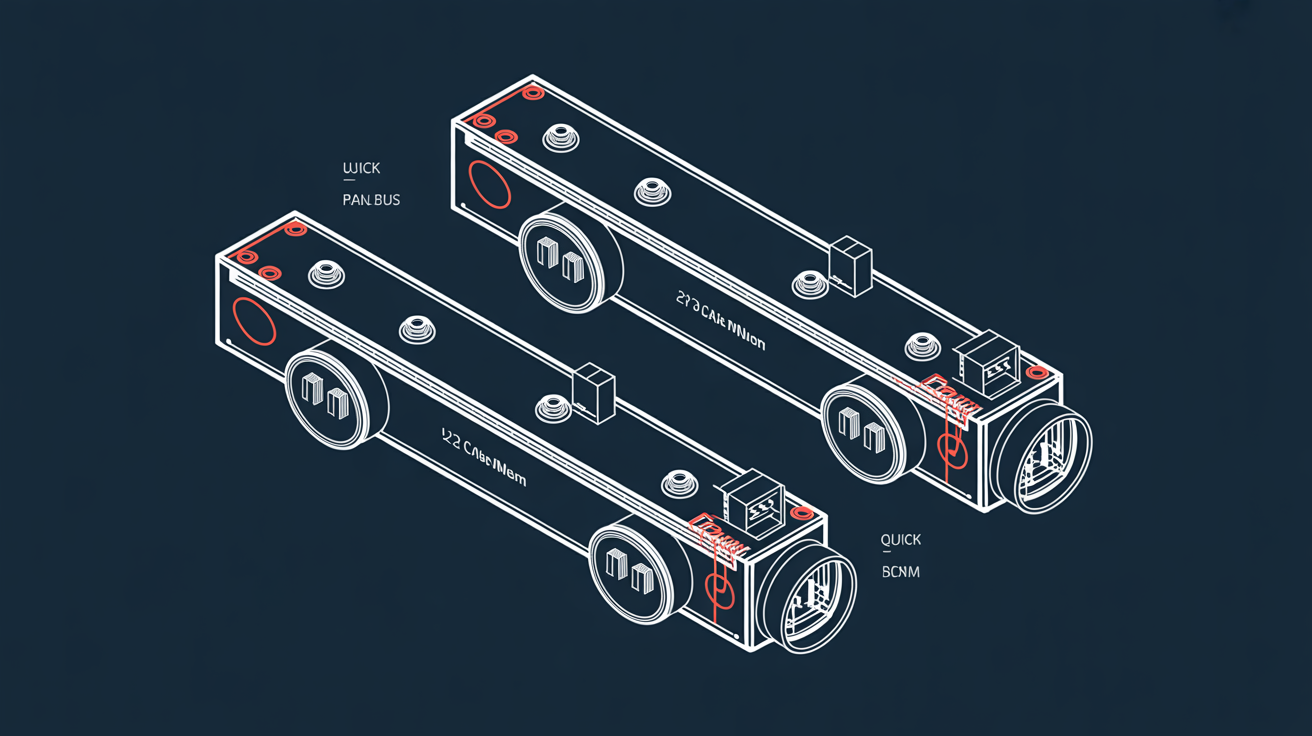
A robot dog without a payload interface is a fixed-function machine. The patrol mission described in this survey demands something different: a structural spine and electrical bus that let future add-ons bolt on and unplug without rebuilding the chassis. This volume examines why that interface matters, how the two leading commercial platforms (Boston Dynamics Spot and Unitree Go2/B2) solve it, what connector and mechanical standards apply, how to budget power across competing payloads, and how this build’s own spine and deck are specified to remain future-proof. Safety interlocks for active payloads close the volume.
9.1 Why a Payload Interface
A robot designed for a single mission bakes assumptions into every structural and electrical decision. When the mission changes — or when capability is added in phases — those assumptions become liabilities. A payload interface inverts that dynamic: the platform is designed once, the spine is load-rated once, the connectors are placed once, and all future capability arrives as a bolt-on payload that plugs in and registers with the flight software. The cost of adding a new sensor mast or carry pack drops from a chassis redesign to a one-afternoon integration task.
The architectural concept is borrowed from aerospace: the base vehicle provides structural mounting, power, and communications; the payload brings domain capability. On a patrol dog, the payloads most likely to cycle in and out include a thermal or daylight camera mast, a wireless communications relay, a carry pack for small cargo transport, a manipulator arm for gate-latch or door-handle tasks, and — in a purely interface sense — any electromechanical system whose weight, recoil load, power draw, and mounting envelope fall within the rated limits.
Designing the interface before the first payload is the only sequence that works. Retrofitting a structural interface onto an already-built chassis means rethinking fastener placement, deck stiffness, wire routing, and connector ingress protection at a point when all of those decisions are already constrained by neighboring parts. The spine and deck described in Vol 7 carry the mechanical interface as a first-class design output precisely for this reason.
9.2 How Boston Dynamics Spot Does It
Spot is the closest production analog to the patrol dog this program is planning, and its payload system is the most thoroughly documented in the commercial quadruped market. Understanding Spot’s interface informs every decision in this build’s own payload deck.

9.2.1 Mechanical mounting
Spot’s payload envelope is 850 mm × 240 mm × 270 mm (L × W × H) over the robot’s dorsal surface [2]. The recommended maximum payload width is 190 mm to avoid interference with the legs during gaited motion [2]. Structural attachment is via M5 T-slot rails on the robot’s back; payload designers bolt to the rails at any point along the 850 mm span [2]. The Spot Arm accessory weighs 8 kg and occupies most of the front rail positions, leaving rear positions for secondary payloads; the arm counts against the 14 kg combined limit [2].
9.2.2 Payload electrical limits
Spot presents two payload ports, each terminated in a DB25 socket on the robot side (payloads mate with a DB25 male connector) [1]. The published electrical limits are:
- Payload mass: 14 kg total combined across all payloads [2][4]
- Bus voltage: 35–58.8 V, unregulated battery bus; absolute maximum 72 V [1]
- Power per port: 150 W maximum average [1]
- Combined current: 9–13 A across both ports simultaneously; overcurrent protection trips and disables payload power [1]
- Port count: two payload ports [1]
The voltage range reflects Spot’s lithium battery chemistry — the bus rises toward ~58.8 V on a full charge and drops toward 35 V as the pack depletes; payload power converters must tolerate the full swing [1].
9.2.3 Data and timing interfaces
Each payload port delivers 1000BASE-T Gigabit Ethernet via pins 1–4 and 14–17 of the DB25 [1]. A 1 Hz pulse-per-second (PPS) timing signal with 5 ppm accuracy is available on pin 7, enabling payloads requiring time-synchronized data acquisition to align with the robot’s internal clock [1]. Safety interlocks are exposed as four contact pairs on the connector: payload power hold-off, motor power hold-off, and two spares — a payload can signal the robot to cut its own power or halt motor output via these lines [1].
9.2.4 Payload SDK
Boston Dynamics publishes an open Payload SDK that allows a payload to register as a first-class entity on the robot’s service graph, issue motion commands, request E-stop authority, and stream sensor data from the robot’s onboard sensors [3]. This software boundary — not just a power and Ethernet port — is what makes Spot’s payload ecosystem functionally rich. Third parties build complete sensing and manipulation systems that interoperate with Spot’s autonomy stack without modifying the base robot firmware [3].
9.3 How Unitree Exposes Expansion
Unitree takes a comparable approach on the Go2 EDU and B2 platforms, though the electrical specifications differ substantially from Spot’s battery-bus model.
9.3.1 Go2 EDU expansion dock
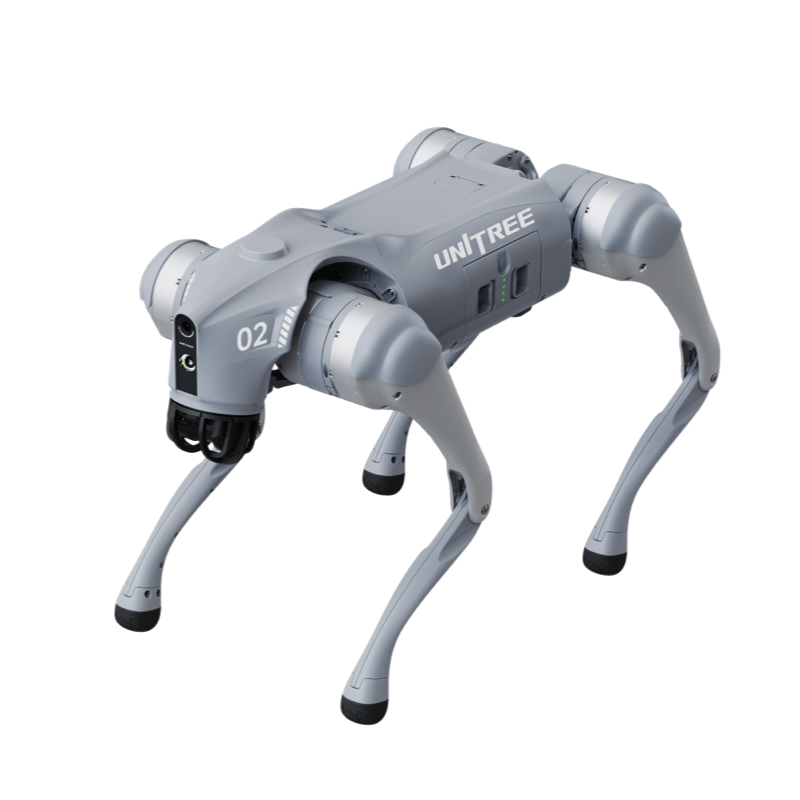
The Go2 EDU (Orin NX 16 GB variant) provides the following interfaces on its dorsal expansion dock [5]:
- DC 28.8 V power output to the expansion module
- USB 3.0 Type-A ×1
- USB 3.0 Type-C ×1
- USB 2.0 Type-C ×1
- Gigabit Ethernet RJ45 ×2
- 100 Mbps Ethernet GH1.25-4PIN ×1
- M8 aviation plug ×1
Payload structural attachment on the Go2 uses M4 screw bosses on the back surface [5]. Maximum payload is approximately 8 kg standard, 12 kg absolute for the EDU/EDU+ variants [5].
9.3.2 B2 expansion power rails
Unitree’s larger B2 platform offers regulated outputs across several voltage rails, all available at the expansion connectors [6]:
- 24 V / 10 A (RS485 connector area)
- 12 V / 10 A (network port area)
- 5 V / 1.5 A (USB 3.0 host)
- 5 V / 3 A (I/O output)
The B2 also exposes Gigabit Ethernet [6]. Unitree quotes the B2 carrying a continuous 20 kg load at walking pace for over four hours, and has demonstrated walking with payloads exceeding 40 kg in controlled conditions [6] — a substantially higher static load rating than the Go2, reflecting the B2’s larger, heavier base chassis and higher-torque actuators.
The B2’s regulated output rails contrast with Spot’s unregulated battery-bus model. Spot puts regulation burden on the payload designer; Unitree’s B2 absorbs that burden into the robot, trading flexibility (payload designers on Spot can draw at any voltage they like, within the 35–58.8 V window) for simplicity (B2 payload designers work with standard 24 V, 12 V, or 5 V rails).
9.4 Mechanical Mount Standard
A payload interface begins with the structural connection. Three geometry elements matter: rail profile, bolt pattern, and quick-release mechanism.
9.4.1 Rails
The spine of this build uses two 30 × 40 mm rectangular aluminum tube rails running longitudinally, matched to the leg-assembly geometry from Vol 7. The rail cross-section provides a combination of bending stiffness (the 40 mm dimension resists dorsoventral bending from payload weight) and torsional stiffness (the closed rectangular section resists twisting under asymmetric payload attachment or lateral ground-contact impulse).
9.4.2 Bolt pattern
Eight M6 threaded boss pairs are spaced on 50 mm centers along a 350 mm active zone, giving payload designers 8 attachment points per side (16 total) and a 7-position choice of fore-aft placement [9]. M6 fasteners at 8.8-class provide generous clamping force for the rated load; the 50 mm pitch allows standard off-the-shelf payload plates and brackets to align to the grid without custom drilling.
9.4.3 Quick-release provisions
For payloads that are swapped between missions (e.g., a carry pack replaced by a sensor mast at the start of a patrol), fixed M6 fasteners require tools. A practical future addition is a spring-loaded lever-lock rail clamp that mates to the T-slot profile of the rails. The bolt pattern remains present and backward-compatible; quick-release clamps thread onto the same M6 bosses but add a tool-free latch. This approach is used on commercial accessory rails (Picatinny, MLOK) and adapted to the robot-payload context by several payload designers in the Spot ecosystem.
9.5 Electrical Bus
The electrical bus connects the robot’s onboard battery and compute to the payload. Four interface types are relevant: primary power, low-voltage logic power, high-speed data, and low-bandwidth fieldbus.

9.5.1 Power rails on this build
The spine carries two regulated power pass-throughs from the main battery regulator, matched to the most common small-payload requirements [9]:
- 12 V / 3 A (36 W) — suitable for cameras, radar modules, single-board computers, and low-power sensors
- 5 V / 2 A (10 W) — suitable for microcontrollers, USB-bus devices, and logic-level peripherals
9.5.2 Data interfaces
A USB 3.2 Gen 1 bulkhead connector provides 5 Gbps serial bandwidth for payloads that communicate via USB — common for off-the-shelf depth cameras, IMUs, and single-board computer USB-A ports [9]. USB also provides up to 0.9 A / 5 V (4.5 W) bus power per the USB 3.x specification [12], making it self-sufficient for lightweight peripheral payloads.
Future provisions will add a CAN bus pass-through (for actuator-dense payloads such as manipulator arms, where CAN is the native fieldbus) and a 1000BASE-T Ethernet port via an M12 D-coded bulkhead (for high-bandwidth payloads such as lidar sensors or AI compute modules that need GbE).
9.5.3 Weatherproof connectors
All deck-side connectors must survive rain, hose-down cleaning, dust, and mud — the patrol environment is outdoors and uncontrolled. The M-series circular connector family is the standard solution in industrial and field robotics.
M12 connectors in the A-coding (general signal and power) and D-coding (Ethernet) are rated IP67–IP69K; some series reach IP69K under high-pressure wash [8]. M8 connectors (3–8 pins) are rated IP66/IP67/IP68 [7]. Both families operate from −40 °C to +85 °C [7][8], covering the all-weather patrol mandate. M12 D-coded connectors carry 1000BASE-T Ethernet; M12 L-coded connectors handle three-phase or high-current power. Brass-nickel or stainless steel shells with gold-plated contacts ensure corrosion resistance in wet outdoor environments [8].
On this build, M12 A-coded panel-mount connectors are the planned choice for the 12 V power pass-through and CAN bus; M12 D-coded for the Ethernet port; a standard IP67-rated USB 3.x Type-B bulkhead for the USB port (IP-rated USB bulkheads are available from several industrial connector manufacturers at modest cost).
9.6 Power Budgeting for Payloads
Payload power budgeting begins with the battery’s available reserve after all drivetrain, compute, and sensor loads are satisfied. Vol 7 established the battery and power architecture for this build; the spine’s payload budget sits downstream of those allocations.
The 12 V / 3 A rail provides 36 W to the payload zone. The 5 V / 2 A rail provides 10 W. Combined, the two rails offer 46 W of regulated payload budget. For context:
- A typical IP camera with onboard compression draws 8–12 W at 12 V (representative; varies by model).
- A Jetson Orin Nano 4GB in 10 W TDP mode (Mode 0, the module default) runs on 5 V or 12 V input, drawing up to 10 W peak [10].
- A mid-range 2D lidar (e.g., Hokuyo UTM-30LX) draws approximately 8.4 W at 12 V (0.7 A typical; up to 12 W peak at 1.0 A) [11].
- A UHF radio relay module draws 3–8 W depending on transmit power (representative; transmit-power dependent).
- A passive carry pack (rigid shell, no active electronics) draws 0 W.
A combined sensor mast — camera + lidar + radio — might draw 20–28 W on the 12 V rail and 5–10 W on the 5 V rail, leaving comfortable headroom within the 46 W total. A manipulator arm with brushless servos could draw 30–80 W under load; that class of payload would require a direct connection to the main battery bus (post-regulator, pre-limit, with its own regulation and fusing) rather than the regulated payload rails — an expansion provision to plan for in the deck wiring harness.
Power-draw budgeting must include worst-case simultaneous load, not average load. Sensors and radios spike on transmit; arms spike at stall. Fusing must be sized to the rail’s continuous rating (3 A on the 12 V rail, 2 A on the 5 V rail) with resettable polyfuses preferred over one-time blade fuses for field serviceability.
9.7 Example Payloads
The following examples illustrate how the mechanical and electrical interface accommodates a range of missions. Each is described only in terms of its interface requirements.
Carry pack. A rigid shell carry pack for small cargo transport occupies the full 350 mm active zone and uses 4–8 M6 bolt positions for a non-removable installation or all 16 for maximum attachment. Mass budget: 1–3 kg empty, up to 3 kg payload (total 3–6 kg [9]; the 3 kg dynamic limit governs during trot; note that the 6 kg upper end would exceed the 5 kg rated static deck limit — a carry pack loaded to this level requires static-load verification before use, as the SF=2.5 structural margin provides physical headroom but does not override the rated limit). Power: zero (passive shell). Data: none. The carry pack is the simplest case and imposes no electrical requirements.
Sensor mast. A vertical mast carrying a daylight + thermal camera pair, a small lidar, and a UHF/WiFi radio relay. Mass budget: 0.8–1.5 kg. Power: 20–30 W on the 12 V rail plus 5–8 W on the 5 V rail for the compute node. Data: USB 3.2 Gen 1 for camera streams; Ethernet for lidar if M12 D-coded port is installed; CAN is not required. The mast is the highest-data-rate payload and drives the bandwidth specification of the USB and Ethernet ports.
Manipulator arm. A lightweight 3–4 DOF arm for latch and handle tasks. Mass budget: 1.5–3 kg. Power: 30–80 W at stall, requiring a direct-battery-bus tap through an arm-specific regulator and fuse, not the regulated payload rails. Data: CAN bus (the natural fieldbus for multi-axis servo systems). The arm drives the provision for a CAN bus bulkhead and a heavy-current direct-bus connector on the deck.
Airsoft-class payload (interface case only). An airsoft mechanism of this type represents an interface challenge analogous to a compact electromechanical actuator. The critical deck-load parameters are: estimated mass 0.6–1.2 kg (compact airsoft mechanisms with battery; based on published airsoft AEG product-mass data), recoil impulse approximately 0.5–2 N·s per shot (conservative estimate based on published AEG cycle-force data; comparable to a hard mechanical click), mounting envelope fitting within the 190 mm recommended width and the 350 mm active zone, and peak electrical draw 5–15 W from the 12 V rail during fire. These parameters fall comfortably within the rated interface limits. No fire-control, targeting, or trigger-actuation content is addressed in this survey; the mechanism is treated identically to any other electromechanical actuator payload.
9.8 Designing the Spine/Deck to Be Future-Proof
Three engineering practices make a payload deck durable across future payload generations: symmetry, reserve, and provision.
Symmetry. The M6 boss grid on 50 mm centers is bilaterally symmetric about the robot’s longitudinal centerline. A payload designed for the left half of the deck can be mirrored to the right without changes; center-mounted payloads attach symmetrically. Asymmetric mass loading — acceptable within the static limit — is a known, documented condition rather than a design surprise.
Reserve. The mechanical limit (5 kg static, 3 kg dynamic from Vol 7) was calculated with a safety factor of 2.5 at 276 MPa yield. The electrical limits (36 W at 12 V, 10 W at 5 V) were chosen to leave headroom against the battery budget. Both reserves accommodate heavier or higher-power payloads introduced later in the build ladder without requiring structural changes, provided the new payloads stay within the rated envelope. If a future payload exceeds the regulated rail budget, the provision for a direct-battery-bus tap (a fused heavy-current connector on the deck harness) means the structural and mechanical interface is still reused — only the wiring tap changes.
Provision. The deck harness routes conduit space for three additional conductors beyond the two regulated rails and the USB line: one CAN bus pair (for arm or fieldbus payloads), one 1000BASE-T Ethernet pair (for high-bandwidth payloads), and one spare shielded pair for future use. These conductors are pinned in the harness even if their bulkhead connectors are not installed in Phase 1. Adding a new interface type in Phase 2 then requires only adding a panel-mount connector and a short stub cable — not re-running the harness.
Provision for waterproofing extends to conduit routing: the deck wiring harness exits the spine rails through grommet-sealed pass-throughs rather than open slots, so deck-level water cannot track down into the body cavity along the wire bundle.
9.9 Safety and Interlocks for Active Payloads
A payload that can actuate — move an arm, spin a motor, fire a mechanism — requires safety interlocks that prevent unintended operation and allow the flight controller to halt all payload activity on demand.
Hardware E-stop line. The deck harness includes a dedicated normally-open E-stop signal line (logic level, pulled to 3.3 V). When the flight controller asserts E-stop (e.g., on fall detection, loss of comms, or low battery), it pulls this line low. Active payloads that can cause injury or damage must monitor this line and halt all actuator output within 50 ms. The signal is carried alongside the power rails on the M12 connector; payload designers are required to implement the monitoring circuit on their payload board, not rely on software alone.
Power-rail enable. The 12 V payload rail is gated through a logic-level N-channel MOSFET on the deck controller board. The flight controller enables the rail after verifying payload registration; it cuts the rail on E-stop, communication loss, or voltage sag below a threshold. The 5 V rail is not gated (microcontrollers need power for safe-state logic even after the main actuator power is removed) but is fuse-protected.
Thermal and current monitoring. A current-sense resistor on the 12 V rail feeds an ADC channel on the deck controller. Software monitors running average current and cuts the rail if it exceeds 3 A sustained for more than 2 seconds, or exceeds 5 A instantaneously (polyfuse backup). Temperature of the power MOSFET and the sense resistor is monitored; a 70 °C threshold causes a warning; 90 °C causes a rail cut and fault log.
Registration protocol. Active payloads are required to send a capability registration packet over the CAN or USB interface within 5 seconds of power-on. The registration declares the payload type, maximum continuous current draw, E-stop response capability, and a checksum. The flight controller does not enable the 12 V gated rail until registration is received and validated. This protocol prevents an unknown or misconfigured payload from drawing power or actuating.
Passive payloads (carry packs, rigid mounts with no electronics) are exempt from registration. The flight controller detects their presence by the absence of a registration packet and leaves the gated rail disabled, drawing no current from the battery.
Sources
- Boston Dynamics, “Robot Electrical Interface,” Spot Payload SDK Documentation, https://dev.bostondynamics.com/docs/payload/robot_electrical_interface.html (accessed 2026-06-19)
- Boston Dynamics, “Payload Configuration Requirements,” Spot Payload SDK Documentation, https://dev.bostondynamics.com/docs/payload/payload_configuration_requirements.html (accessed 2026-06-19)
- Boston Dynamics, “Payload SDK README,” Spot Payload SDK Documentation, https://dev.bostondynamics.com/docs/payload/README.html (accessed 2026-06-19)
- Boston Dynamics, “Spot Specifications,” Boston Dynamics Support, https://support.bostondynamics.com/s/article/Spot-Specifications-49916 (accessed 2026-06-19)
- Unitree Robotics, “Go2 EDU Overview,” Quadruped Documentation, https://www.docs.quadruped.de/projects/go2/html/Overview_1.html (accessed 2026-06-19)
- Unitree Robotics, “B2 Overview,” Quadruped Documentation, https://docs.quadruped.de/projects/b2/html/B2_overview.html (accessed 2026-06-19)
- NorComp, “M8 Connector Series,” https://www.norcomp.net/series/m8-connector (accessed 2026-06-19)
- Amphenol LTW, “M8 vs M12 Connectors,” https://amphenolltw.com/news-events/m8-vs-m12-connectors.html (accessed 2026-06-19)
- RoboDog Phase 1 survey, Vol 7 — Build 3: The Full-CNC Heavy-Duty Finale (this series), 2026-06-19. (Internal cross-reference; spine rail dimensions 30×40 mm / M6 boss grid / 350 mm active zone; regulated power pass-throughs 12 V/3 A and 5 V/2 A; USB 3.2 Gen 1 data interface.)
- NVIDIA, “Jetson Orin Nano Series Power Modes,” Jetson Linux Developer Guide r35.4.1, https://docs.nvidia.com/jetson/archives/r35.4.1/DeveloperGuide/text/SD/PlatformPowerAndPerformance/JetsonOrinNanoSeriesJetsonOrinNxSeriesAndJetsonAgxOrinSeries.html (accessed 2026-06-19). (Confirms Jetson Orin Nano 4GB Mode 0 = 10 W TDP.)
- Hokuyo Automatic Co., “UTM-30LX Scanning Laser Rangefinder,” product page, https://www.hokuyo-aut.jp/search/single.php?serial=169 (accessed 2026-06-19). (Power: 12 VDC ±10%; 0.7 A typical / 1.0 A maximum → 8.4 W typical, 12 W peak.)
- Wikipedia contributors, “USB 3.0,” Wikipedia, https://en.wikipedia.org/wiki/USB_3.0 (accessed 2026-06-19). (Per USB-IF USB 3.0 specification: maximum 900 mA at 5 V VBUS = 4.5 W for SuperSpeed downstream ports.)
Comments (0)